Category Archives: On Writing

Notes from a ConQuesT 52 Foodie

close up photo of sliced bread on oval wooden plate

Photo by Marta Dzedyshko on Pexels.com

I spent much of the 2021 Memorial Day weekend attending (virtually) ConQuesT 52, the annual SF and fantasy convention presented by the Kansas City Science Fiction and Fantasy Society. The many interesting panel discussions included Neurodiversity in Star Trek; Trials and Tribulations of Running an Interstellar Space Station; Being Creative in 2020: Building Community, Visibility, and Audience in a Virtual World; and my personal favorite, “Food in Fantasy.”

That one got me thinking about the many ways in which food comes to the fore in Waterspell, starting with Carin’s near-starvation on her long journey as she’s forced to beg or steal what food she can, but survives mostly on the rabbits she kills and the roots and berries she forages. Then the housekeeper Myra enters Carin’s life, feeding her better than she’s eaten in years. In Myra’s kitchen, around the trestle table, we learn much about the resident warlock and his small household.

Finding, cooking, and eating food provide endless opportunities for character development and story progression. Seeing the warlock throw down a glass of something alcoholic during tense moments, or when he needs time to think, gives us a glimpse of the inner man. Watching the characters gather for a meal, listening to their dinner-table talk, we catch the nuances in their phrasing and read meaning in their pauses. I’m hard-pressed to imagine how the story could have developed without meal breaks providing opportunities for the characters to reveal their hidden sides and crack open one other’s emotional shells from time to time.

Foods and beverages also lend themselves to writing that touches all the senses. Not only “How does it taste?” (tart, sweet, salty, bitter … ) or “How does it smell?” (spicy, burnt, savory, fruity, gamy … ) but “How does it feel in the mouth?” Is it crunchy or creamy, chewy or tender, slimy, sparkling, wet, dry, or maybe still moving? What does it sound like as it cooks over an open fire? Is the pot bubbling, the meat sizzling? What does it look like? Colorful fruits and vegetables, pastries, breads and sauces? Brown gravies and browner meats? Or does the food look as gray as a dungeon’s walls, or as green as a cup of poison? When writing about food, a writer can pull out all the descriptive stops, for it’s a sure bet that food has significance for every reader.

The ConQuesT panelists discussed the close ties between food and culture: how rice may call to mind one cultural tradition, for instance, while potatoes evoke another, and haggis another. The work of Brian Hayden was mentioned, particularly his book The Power of Feasts, which explores the practice of feasting from prehistoric to modern times, revealing patterns and links to other aspects of culture such as food, personal identity, power, and politics.

Speaking of personal identity, the panelists commented on the ways in which foods and beverages can become character hooks: Star Trek’s Captain Picard likes “Tea. Earl Gray. Hot.” Counselor Deanna Troi craves chocolate. My own Waterspell warlock drinks dhera, occasionally to excess.

I enjoyed this year’s virtual ConQuesT and appreciated the chance to attend the panel discussions without needing to travel to KC. To learn more about ConQuesT—Kansas City’s original Science Fiction Convention held annually on Memorial Day Weekend—and the convention’s sponsor, Kansas City Science Fiction and Fantasy Society, please visit their website. Scroll to the bottom of the page to sign up for their email list. I signed up and look forward to getting more involved. Maybe next year, I’ll be in KC on Memorial Day.


Leave a Comment

Filed under Books and Readers, On Writing, Waterspell fantasy trilogy, Writers

Favorite Quotes #1

“All journeys have secret destinations of which the traveler is unaware.”—Martin Buber

“Mistakes are the usual bridge between inexperience and wisdom.” —Phyllis Theroux


“Take the course opposite to custom and you will almost always do well.” —Jean-Jacques Rousseau


“Drift beautifully on the surface and you will die unbeautifully in the depths.” —Richard Ellmann


“The respect of those you respect is worth more than the applause of the multitude.” —Arnold Glasow


“Patience is a minor form of despair disguised as a virtue.” —Ambrose Bierce


“The soul that has no fixed goal loses itself; for as they say, to be everywhere is to be nowhere.” —Michel de Montaigne


“Anything you’re good at contributes to happiness.” —Bertrand Russell


“Shun idleness. It is a rust that attaches itself to the most brilliant metals.” —Voltaire


“The best way to be boring is to leave nothing out.” —Voltaire


“Stupidity lies in wanting to draw conclusions.” —Gustave Flaubert

Leave a Comment

Filed under Books and Readers, On Writing, Writers

Writing Systems and World Building

The title of The Hobbit, translated. Screenshot from Professor Marc Zender’s “Writing and Civilization: From Ancient Worlds to Modernity.”

Continuing through my collection of Great Courses—sets of DVDs that I rediscovered in my bookshelves after forgetting I owned them—I turn today to Professor Marc Zender’s “Writing and Civilization: From Ancient Worlds to Modernity.”

The course’s overview of writing systems from Sumerian cuneiform and Egyptian hieroglyphs to Mayan and Aztec glyphs is fascinating, as is the discussion of the origins of the Roman alphabet. (Flip a capital A upside down and you’ll see an animal’s head with horns. The name of the letter alpha derives from the Hebrew aleph, meaning “ox.” The shape of the letter derives from an earlier symbol resembling the head of an ox. B started as a picture sign for a house in Egyptian hieroglyphs. In Semitic languages the sign was called beth, meaning “house,” but the Greeks changed the name from beth to beta. And so on through the letter Z, adopted from the Etruscans, who got it from the Phoenicians.)

While it’s all been interesting, the lecture nearest to my heart, as a writer and reader of fantasy, deals with so-called featural scripts, including the invented, fictional alphabets designed for works of fantasy and science fiction. The inventions of J.R.R. Tolkien are standouts in this category.

Professor Zender devotes a satisfying amount of time to Tolkien’s writing systems, pointing out that Tolkien was a professional linguist and a specialist in the history of Germanic languages and scripts, both alphabetic and runic. Quoting from the course guidebook:

“In The Hobbit, first published in 1937, Tolkien used Anglo-Saxon runes as a kind of code for Modern English. Tolkien also invented several writing systems of his own, including the cursive script known as Tengwar or Tîw (meaning ‘letters’) and the angular characters designed for cutting into wood, stone, or metal known as Certar or Cirth (meaning ‘runes’). … He even gave his fictional scripts a fictional inventor, Rúmil. … Tolkien provides charts and full descriptions of his writing systems in appendix E of The Lord of the Rings.”

I confess that, until now, I had barely glanced at Appendix E. After completing this series of lectures, however, I got out my much-loved, much-read 1975 Ballantine Books boxed set of LOTR and took a closer look. The knowledge I gained from Professor Zender about the development of “real” writing systems deepened my appreciation for Tolkien’s achievement in creating his fictional scripts and giving them such deeply thought-out histories.

I’ve not gone so far as to invent an alphabet, but I have imagined several specific words in my fictional language of Ladrehdin. My audiobook narrator is having a field day with them.

Now … Anyone up for learning Quenya? Or Sindarin?

From the slipcase of The Lord of the Rings, 1975 Ballantine Books boxed set.

Leave a Comment

Filed under Books and Readers, On Writing, Writers

Two Kinds of Literature: Quest and Coming of Age

It pays to prowl through one’s bookshelves occasionally. Tucked away on mine, I found four Great Courses (lectures from The Teaching Company) that I’d forgotten I owned. They were still in their shrink-wrap.

Of the four, I gravitated immediately to “The Terror of History: Mystics, Heretics, and Witches in the Western Tradition,” taught by Teofilo F. Ruiz, Ph.D., history professor at UCLA.

Two-thirds of the course (lectures 1 through 13) dealt with Christian mystics and Christian notions of heresy, which mostly left me shaking my head at the horrific damage that organized, institutionalized religion (in all its forms) has inflicted upon human society and hapless individuals, from ancient times to the present day.

By far, the most interesting thing in those opening lectures was a passing reference to “quest literature” and the professor’s comment that there are really only two kinds of literature:

● The Quest — the searching for something
● The Coming of Age — growing up

You might have heard it argued (elsewhere) that there are six core types of stories:

1. Rags to riches – a steady rise from bad to good fortune
2. Riches to rags – a fall from good fortune to bad, a tragedy
3. Icarus – a rise, then a fall in fortune
4. Oedipus – a fall, a rise, then a fall again
5. Cinderella – rise, fall, rise
6. Man in a hole – fall, rise

Smh again. That list seems overly complex and obviously repetitive. I prefer Professor Ruiz’s neatly succinct take on the matter, for it appears to me that the six “types” of stories can all be folded into his two kinds of literature.

All of that business about good and bad fortune falls under the heading of a Quest. Characters go seeking greener pastures or pursuing happiness. They may or may not find what they seek. They may rise, they may fall, they may succeed or fail in their quest.

Just as clearly, Cinderella and Icarus are Coming of Age stories. Cinderella is an archetypal model (now outdated) of female coming-of-age: she found her Prince Charming. On the male side, Icarus is a story of youthful hubris, of a son’s folly in ignoring his wise old father’s instructions, and thus failing to reach manhood.

Perhaps I’m especially drawn to Professor Ruiz’s “two kinds of literature” because my Waterspell series fits perfectly into his view of the matter. Waterspell tells of a quest (the characters travel far, do great deeds, and eventually make their way home). It’s also the story of a young woman’s coming of age, of discovering her inner strength and making a place for herself in a world where she didn’t think she belonged.

So count me on your side of the argument, Professor Teo. There are only two kinds of literature.


1 Comment

Filed under Books and Readers, On Writing, Writers

Touching the Senses: Smell

“Researchers plan library of scents from plague repellents to early tobacco”

In the works: an online encyclopedia of European odors between the 16th and early 20th centuries. What a fabulous resource this will be for writers needing to describe the smell of (for instance) a sorcerer’s library filled with musty old books, or a chatterbag housekeeper’s richly scented kitchen.

“Once you start looking at printed texts published in Europe since 1500 you will find loads of references to smell, from religious scents – like the smell of incense – through to things like tobacco,” said Dr. William Tullett of Anglia Ruskin University in Cambridge, a member of the Odeuropa team and the author of Smell in Eighteenth-Century England.

The first step in the three-year project, which is due to begin in January, will be to develop artificial intelligence to screen historical texts in seven languages for descriptions of odours – and their context – as well as to spot aromatic items within images, such as paintings.

That information will be used to develop an online encyclopaedia of European smells  …

See the full article in The Guardian at https://www.theguardian.com/science/2020/nov/17/scents-of-history-study-hopes-to-recreate-smells-of-old-europe

Leave a Comment

Filed under Books and Readers, On Writing, Waterspell fantasy trilogy, Writers

Give Webnovel a Hard Pass

Should I be flattered? I think not.

Like many writers, I got the email:

My name is May. I’m an Author Liaison representative, representing Webnovel.

I found your work Waterspell Book 1: The Warlock, which comes highly recommended … I am very interested in a business collaboration with you, and would like to offer you a Non-Exclusive Contract that will not affect your novel distribution and earnings [through other distributors]. We think that the theme and genre of your novel would be a great fit for our readers here on Webnovel.com

The message instantly triggered my scam radar, and a quick online search confirmed my suspicions. Says Terrance Phillipe aka Whatsawhizzer:

“Qidian [Webnovel] doesn’t give a shit about things like copyright or human decency.”

If you get a solicitation email from Webnovel, please don’t respond before you read the blog post “Why Do People Hate Qidian Webnovel?” Indeed, I’d recommend that you not respond at all. Webnovel is just another way to cheat a writer.


Leave a Comment

Filed under Books and Readers, On Writing, Writers

Ruminations on the Third Draft of the Fourth Book (with a blurb-in-progress)

When I sat down to write a fourth book in my Waterspell fantasy series, I wondered whether I still had enough to say about my characters and their world to produce a novel-length work. Turns out, I needn’t have worried. I got Drafts 1 and 2 down on paper in record time: started May 6; had a nearly complete second draft by September 6. After leaving the manuscript sitting for a couple of weeks, I started again at the beginning of the story, checking it against my stacks of notes, looking for loose ends and adding material to address every thread that I wanted to bring forward from the original trilogy. The result is a third draft that’s very nearly complete at just shy of 90,000 words. Book 4 will be the shortest in the series. The previous record-holder for “short” was Book 3, at about 115,000 words.

Book 4’s conciseness stems partly from my not needing to include so much description. The story takes place in settings that readers already know from Books 1 through 3.

I’m aware, however, that I’m relying more on narration in Book 4 than I did in the previous volumes. Between now and the early months of 2021, I plan to let the story sit largely untouched as I hear back from my beta readers and get some distance from the narrative. I’m a bit concerned that this story lacks the immediacy of Books 1 through 3, which were built on you-are-there, “real-time” scene-and-sequel with lots of dialogue and limited narration. Detailed scenes take more words to lay out for the reader than narration requires.

As a writer (and as an individual) I’m in a very different place from who and where I was when I finished the trilogy. It’s no surprise, to me, that my approach to Book 4 differs in tone from the original books. I’m trusting my beta readers (and my gut, once it has gained the necessary distance) to tell me whether my approach to Book 4 will satisfy readers who enjoyed the original story of Carin and Verek, or whether the “new me” is straying too far from readers’ expectations.

In the meantime, here’s the working draft of the book blurb. Any and all comments will be appreciated:

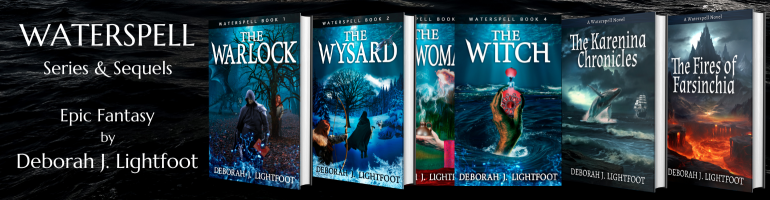
It’s five years later, Carin and Verek are married with children, and the grandparents are calling. Readers of the Waterspell fantasy series will welcome this long-awaited fourth book for the answers it provides to questions raised in volumes 1 through 3: Does the wysard Verek regain his powers, and will Carin make her way back to him? Have Carin’s parents survived the bleeding disease that devastated Earth, and will Carin ever see them again? How is the woodsprite faring in its new world? Has it forgiven the treachery committed by its greatest friend? Will Carin ever forgive herself for abandoning the creature? Does Megella get her wish, to be the wisewoman who midwifes Carin’s children into the world? Will those children bear the mark of their ancestry, or are they fated to be disappointingly ungifted? Did Lanse survive? Is Lord Legary really dead? And not least: Did the necromancer die in the jaws of Carin’s conjured dragon? Remember: There was no blood in the water. These questions and more are answered in Waterspell Book 4: The Witch, which picks up the story of the lovers, Carin and Verek, five years after readers last saw the pair separated in the closing chapters of the series’ third book.
By the blood of Abraxas, it’s about time we learned what happened next.

2 Comments

Filed under Books and Readers, On Writing, Waterspell fantasy trilogy, Writers

Where Do Ideas Come From?

My habit of letting the draft of a novel sit for at least two weeks has paid off: On my walk this morning, I suddenly got an interesting idea for introducing a plot twist that will bring readers face-to-face with characters who have previously appeared only in the background. Adding this element to Draft 3 will require additional writing but minimal rewriting. The idea arrived, seemingly out of nowhere, on the 14th day of me setting the ms. aside to marinate in its own juices. The subconscious is a powerful asset when it’s allowed to work its magic in its own time and way.

Leave a Comment

Filed under Books and Readers, On Writing, Writers

When Characters Speak

I’m having a great time working with a skilled, extraordinarily talented professional narrator to turn the first three books of Waterspell into audiobooks. The way the narrator has moved into the body of my wysard is uncanny. The man sounds exactly like the voice I heard in my head during all the years I devoted to writing Books 1 through 3. I look forward with eager anticipation to each newly recorded chapter the narrator sends me. He’s finished Waterspell Book 1: The Warlock and is approaching the one-third mark of Book 2: The Wysard. We plan to release both audiobooks together or within about a month of each other, since Book 1 ends on a cliffhanger and I believe listeners will want to move immediately into Book 2.

For me, an unexpected side benefit of hearing my characters’ voices come alive in the real world, is the inspiration this experience has provided to finally get me writing again. After my husband’s sudden death in 2012, I had no impulse to write. People would ask about a possible Book 4, and all I could tell them was that Life with a capital L had kicked me hard, and I wasn’t writing. Then came 2016, and the shock of discovering that I wasn’t living in the country I thought I was living in. The country of my birth was, in fact, a breeding ground for the absolute worst in human nature.

Therefore, after spending four years trying to patch together my life, I found myself obliged to join the Resistance and spend the next four years attempting to save the soul of my nation.

Then came 2020 and Covid-19, and a months-long self-isolation that has been a godsend for me. I hate the pain, the loss, the suffering that this virus has heaped on other people’s heads. I’m a walking example of white privilege: I get to stay home, safely isolated out in the country, ordering stuff for delivery to my gate and going into town only to pick up groceries and my mail. My pandemic experience has been 180 degrees from the devastation that others have experienced.

After years of no motivation followed by years of exhausting nonstop effort to resist the tide of fascism, I suddenly found myself with both the time and the desire to create something of my own again. Almost immediately upon entering my bubble of self-isolation, I hired my audiobook narrator. After six or seven weeks of listening to his breathtakingly good interpretations of my characters and their story, I placed my fingers upon the keyboard and started pounding out Book 4.

I started Draft One on May 6, and completed Draft Two on September 6. Record time for me (Books 1–3 took me 16 years to write and publish).

The second draft will need to sit for a couple of weeks. I do still have obligations to my state and my nation—I’m supporting candidates and contributing to Get Out the Vote efforts. I’ll spend the next couple of weeks engaged in that effort.

But then I’ll be looking through my notes again, and settling down for a close reread and re-edit of Draft Two. I’m tentatively planning a Summer 2021 release date of the Book 4 ebook, to coincide (I hope) with the release of the Waterspell Book 3 audiobook.

How good it is to be writing again. Strange, how inspiration will arrive unexpectedly, and opportunities may arise from cataclysm.


3 Comments

Filed under Audiobooks, Books and Readers, Coronavirus, On Writing, Waterspell fantasy trilogy, Writers

The Fight Against Book Piracy

Authors and publishers have filed suit against book piracy entity Kiss Library,  obtaining a restraining order that requires domain registrars to disable the domains controlled by Kiss Library. Kiss is “a pirate online bookstore based in Ukraine that illegally sells pirated ebooks at discounted prices to unsuspecting U.S. readers. The defendants dress their websites up to make them look like sophisticated, legitimate sites, intentionally deceiving consumers who are unaware that authors, publishers, and legitimate booksellers are being denied their legal share of the sales price,” reports the Authors Guild.

“This filing joins together bestselling and emerging authors with industry leaders in a united fight against piracy,” said Mary Rasenberger, executive director of the Authors Guild. “Every purchase from an illegal piracy site represents a theft of earned income from the author and publisher, causing massive losses to the industry that, over time, will diminish the industry’s ability to publish a wide diversity of voices. This outright theft must stop.”

For more, see “AG Members Join Amazon Publishing and PRH in Suit Against Kiss Library” at News & Events, the Authors Guild.


Leave a Comment

Filed under Books and Readers, On Writing, Writers