Monthly Archives: June 2026

Affordable Legitimate Book Promotion: Written Word Media vs Book Cave

I try to place at least one promotion per month in a newsletter or email such as Book Barbarian, Fussy Librarian, Robin Reads, or the Freebooksy or Bargain Booksy options at Written Word Media. As a service to my fellow and sister authors, I make an annual report on the results. (Details here, with clickable links to the various book-promo sites that I’ve used.)

On April 8, 2026, I ran a series promotion with Written Word Media, at a cost of $170. As shown in the graphic, that promo resulted in 601 book orders for my Waterspell series at Amazon, the majority of those (469) coming on the actual day (a Wednesday) of the “one-day” promotion. But experience has taught me that many people don’t open their emails until a day or two after the promo runs. The five-day cumulative numbers give a truer picture of the promo’s relative success. After the initial first-day flurry, another 132 orders were placed over the next four days, bringing the five-day grand total to 601.

Book promotion sites: Written Word Media vs. Book Cave

Then I ran a full-series promotion (for the six books of Waterspell) at Book Cave, a place I have only recently discovered. Unlike Written Word Media, which offers one-day full-series promotions, you can schedule a multi-day promo at Book Cave at no extra cost for the extra days. My series promo ran from May 30 through June 7. And though it cost only $71, it delivered results very comparable to what Written Word Media had brought in: 577 total orders at Amazon, the majority of them (469 again, seemingly the magic number) coming on May 30–31 (Saturday–Sunday) and the rest (108) trickling in toward the tail-end of the promo period. For epic fantasy with a series add-on, Book Cave charges a cool $99 less than Written Word Media does. See the Cave’s price list here.

Granted, this is only my first experience with Book Cave. I’ve been running full-series promos at Written Word Media for several years, and it’s quite possible that their subscribers have seen my books featured so many times, they scroll past and look for newer titles. But to save $99, I will definitely choose the $71 promo at Book Cave the next time I want to promote my entire six-book series at one time in one place.

For those wanting to dig into this topic in greater detail, I’ll refer you to my earlier posts on my book promo efforts. From these reports, you’ll learn what promo sites I’ve used, and how successful (or not) they have been, at a cost of $45 to $65 at most of the sites I have tried:

Leave a Comment

Filed under Discoverability, Writers

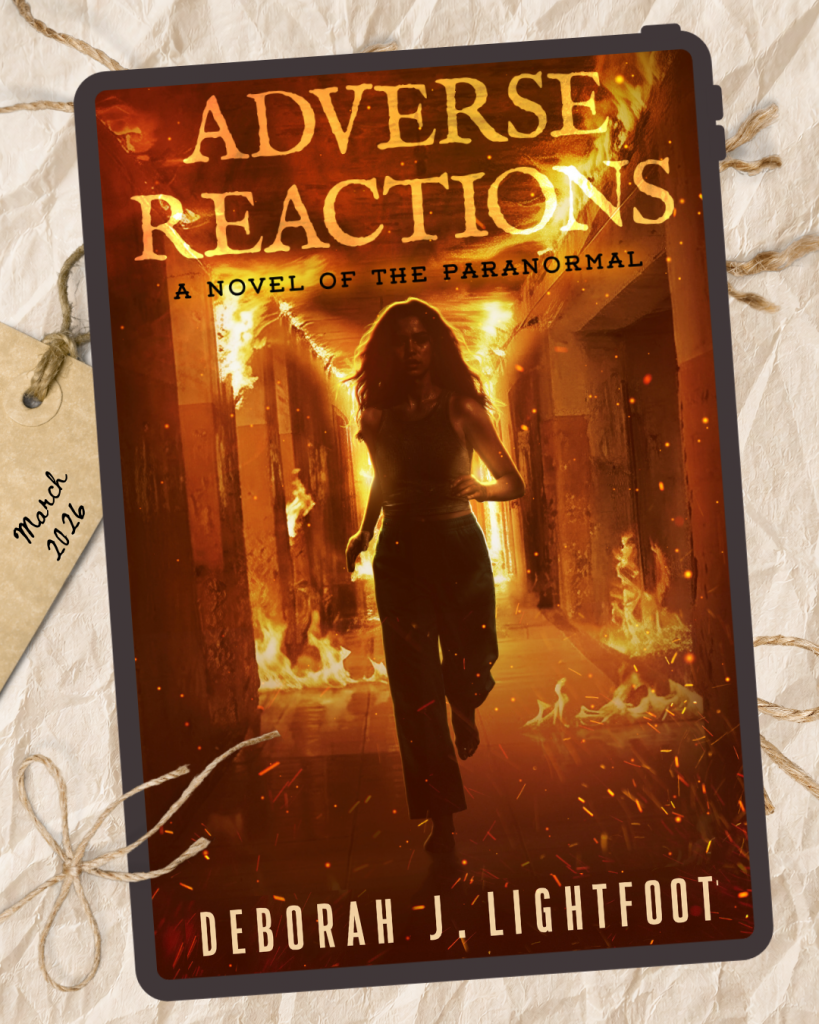
Giveaway: Win a Copy of Adverse Reactions

Goodreads Book Giveaway

Adverse Reactions by Deborah J. Lightfoot

Adverse Reactions

by Deborah J. Lightfoot

Giveaway ends June 28, 2026.

See the giveaway details at Goodreads.

Enter Giveaway

Learn more and read reviews at Goodreads and at Amazon.

Leave a Comment

Filed under Adverse Reactions: A Novel of the Paranormal, Books and Readers

The “Alice” Books and Waterspell: How They Connect

Writers are often told to write what we know. Thus, it is not surprising that many authors choose to write about books and the people who love them.

The Book Thief by Markus Zusak tells of a girl who steals the things she can’t resist—books. The hero of Michael Ende’s The Neverending Story becomes a character in the mysterious book he is reading. In When You Reach Me by Rebecca Stead, the protagonist relies upon her favorite book, Madeleine L’Engle’s A Wrinkle in Time, as a kind of “life compass.”

Pool of Tears

Following in that tradition, Lewis Carroll’s Alice books appear “as themselves” in my Waterspell books. My heroine, Carin, first encounters Through the Looking-Glass (TTLG) and discovers that the book holds within it a powerful weapon that only she can wield. Later, Carin gets her hands on a copy of Alice’s Adventures in Wonderland (AAIW) and continues to find veiled connections between the Carrollian world and her own perilous situation.

As an enthusiastic fan of Martin Gardner’s The Annotated Alice, I like to imagine how the late Mr. Gardner might annotate the Waterspell series as he picked up on my novels’ subtle homages to the Alice books. I think he would remark on the reversed order in which Carin encounters the books. Lewis Carroll wrote AAIW first, then TTLG some years later. Throughout TTLG, things “go the other way,” so it is appropriate (as well as necessary to the plot of Waterspell) that Carin reads the books “the other way”—second book first.

Another play on the “other way” can be seen in the spelling of the names of the two leading ladies. “Alice” is vowel-consonant-vowel-consonant-vowel, while “Carin” (also five letters) is consonant-vowel-consonant-vowel-consonant.

The names of things are important in the Waterspell books. In AAIW, the dormouse speaks of drawing all manner of things that begin with the letter M. I don’t doubt that Martin Gardner would notice the characters in Waterspell whose names start, like his, with M: among them Myra, Megella, and Merriam.

And on it goes. In Waterspell Book 3: The Wisewoman, Carin is required to travel under an alias. What name does she choose for herself? Alice, of course.

In no way, however, are the Waterspell novels a retelling of the Alice books. Though there are analogies—Carin’s reflective “mirror pool” recalls Alice’s looking-glass—my story follows its own unique trajectory. To capture the gist of Waterspell, one might say it’s “Jane Eyre meets a sorcerer.” The relationship between my main characters is reminiscent of the stormy sparring between Jane and Rochester. Waterspell is a story that young adults can enjoy, but it’s really aimed at an older audience. Though an Alice motif runs deep in my series, Waterspell is no more a “children’s book” than is The Hunger Games or Philip Pullman’s epic trilogy of fantasy novels, His Dark Materials. My characters encounter great danger, violence, murder, and betrayal.

 ~~~~~

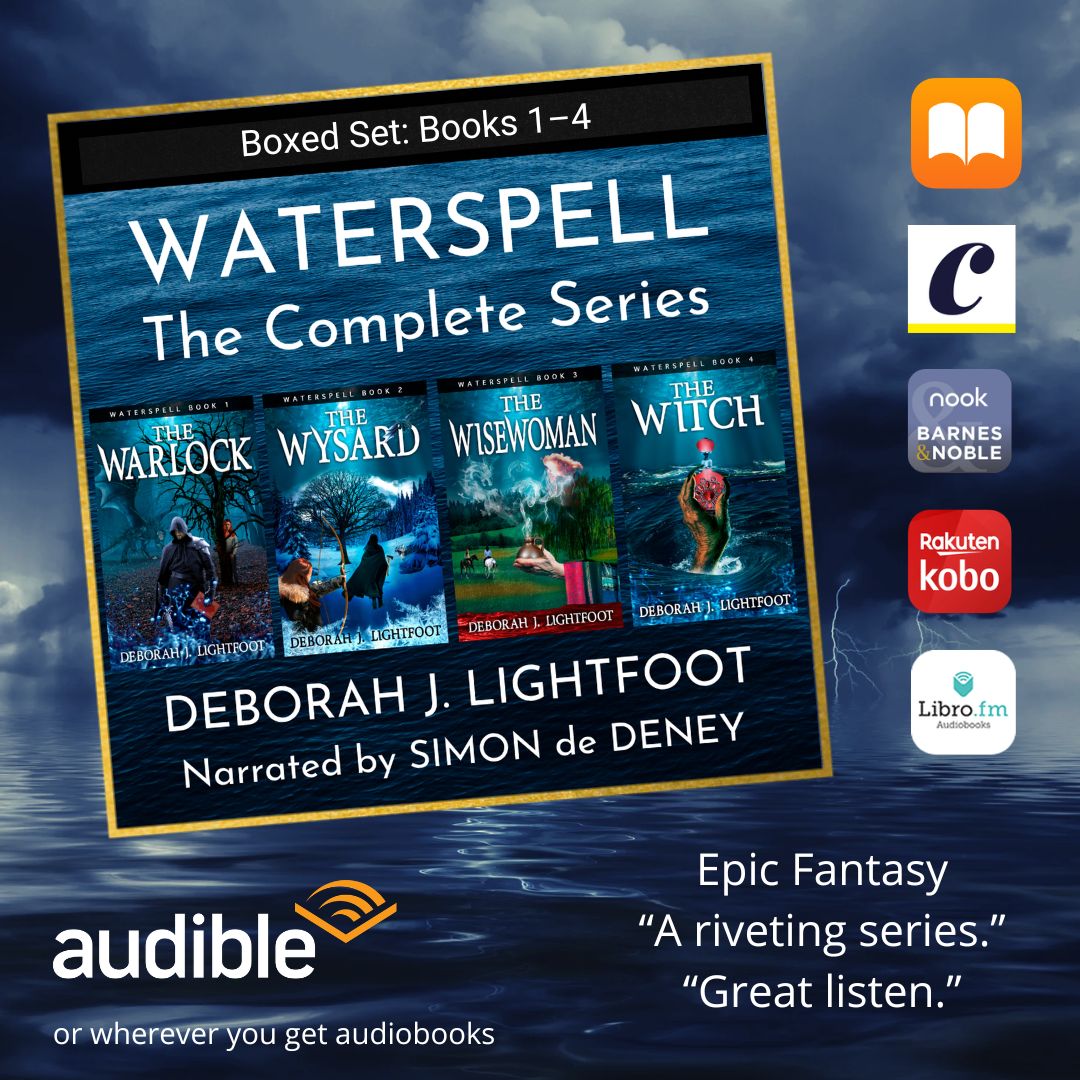
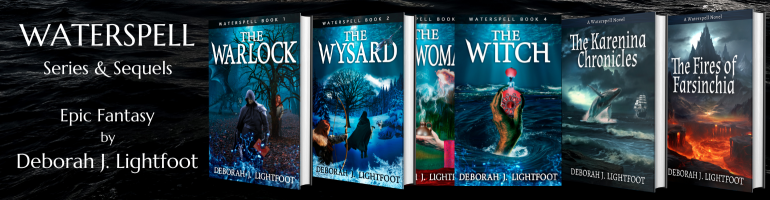
Waterspell fantasy series by Deborah J. Lightfoot

“One of my all-time favourites. The Waterspell series shines in its character development. Readers are introduced to a diverse cast of deeply human, flawed individuals shaped by their pasts—whether through jealousy, grief, or a yearning for freedom. These aren’t flaws added for drama’s sake, but natural consequences of their lived experiences. The changes they undergo are gradual and organic, evolving over the course of the series. If you enjoy slow-burn narratives and meaningful arcs, you’ll appreciate how the story handles growth and transformation. I’d even consider this an ʻenemies-to-lovers’ romance, though it takes three books for that dynamic to fully develop. Patience is key—but it’s worth the wait. Ariel The Tempest

“In this four-book saga, the author has created an epic fantasy world full of magic, danger, romance, and travel through time and space. The characters are vivid and complex, including a young woman on a hero’s quest, and a powerful warlock who isn’t sure whether to kill her or embrace her. This is a most enjoyable read for fans of fantasy and fine writing.” Shirley, NetGalley

“A must-read for fantasy enthusiasts who enjoy immersive world-building, well-developed characters, and a storyline that seamlessly blends magic and human emotion.” —Dalton S, NetGalley


Leave a Comment

Filed under Alice in Wonderland, On Writing, Waterspell fantasy trilogy

Richard Russo: “The writing life is ours to defend.”

Note: Richard Russo wrote this Open Letter in December 2013. Everything he warned about, then, has come to pass. The writing life is endangered by the downward pressure of e-book pricing, by the ongoing erosion of copyright protection, by the scorched-earth capitalism of Google and Amazon, by those who believe art should be cheap or free, and by internet search engines that direct people to sites selling pirated books. Even the single glimmer of hope that Mr. Russo offered in 2013—that Apple, Google, Amazon, Netflix, et al., need writers to provide them with content—is no longer the case. Mega-corporations now use artificial intelligence to churn out “content” for free or cheap. Mr. Russo’s conclusion, however, remains as valid now as when he wrote this letter:

The imaginative lives of us all will be diminished if authorship becomes untenable as a profession.


From Richard Russo:
An Open Letter to My Fellow Authors


It’s all changing, right before our eyes. Not just publishing, but the writing life itself, our ability to make a living from authorship. Even in the best of times, which these are not, most writers have to supplement their writing incomes by teaching, or throwing up sheet-rock, or cage fighting. It wasn’t always so, but for the last two decades I’ve lived the life most writers dream of: I write novels and stories, as well as the occasional screenplay, and every now and then I hit the road for a week or two and give talks. In short, I’m one of the blessed, and not just in terms of my occupation. My health is good, my children grown, their educations paid for. I’m sixty-four, which sucks, but it also means that nothing that happens in publishing—for good or ill—is going to affect me nearly as much as it affects younger writers, especially those who haven’t made their names yet. Even if the e-price of my next novel is $1.99, I won’t have to go back to cage fighting.

Still, if it turns out that I’ve enjoyed the best the writing life has to offer, that those who follow, even the most brilliant, will have to settle for less, that won’t make me happy and I suspect it won’t cheer other writers who’ve been as fortunate as I. It’s these writers, in particular, that I’m addressing here. Not everyone believes, as I do, that the writing life is endangered by the downward pressure of e-book pricing, by the relentless, ongoing erosion of copyright protection, by the scorched-earth capitalism of companies like Google and Amazon, by spineless publishers who won’t stand up to them, by the “information wants to be free” crowd who believe that art should be cheap or free and treated as a commodity, by internet search engines who are all too happy to direct people to on-line sites that sell pirated (read “stolen”) books, and even by militant librarians who see no reason why they shouldn’t be able to “lend” our e-books without restriction. But those of us who are alarmed by these trends have a duty, I think, to defend and protect the writing life that’s been good to us, not just on behalf of younger writers who will not have our advantages if we don’t, but also on behalf of readers, whose imaginative lives will be diminished if authorship becomes untenable as a profession.


I know, I know. Some insist that there’s never been a better time to be an author. Self-publishing has democratized the process, they argue, and authors can now earn royalties of up to seventy percent, where once we had to settle for what traditional publishers told us was our share. Anecdotal evidence is marshaled in support of this view (statistical evidence to follow). Those of us who are alarmed, we’re told, are, well, alarmists. Time will tell who’s right, but surely it can’t be a good idea for writers to stand on the sidelines while our collective fate is decided by others. Especially when we consider who those others are. Entities like Google and Apple and Amazon are rich and powerful enough to influence governments, and every day they demonstrate their willingness to wield that enormous power. Books and authors are a tiny but not insignificant part of the larger battle being waged between these companies, a battleground that includes the movie, music, and newspaper industries. I think it’s fair to say that to a greater or lesser degree, those other industries have all gotten their asses kicked, just as we’re getting ours kicked now. And not just in the courts. Somehow, we’re even losing the war for hearts and minds. When we defend copyright, we’re seen as greedy. When we justly sue, we’re seen as litigious. When we attempt to defend the physical book and stores that sell them, we’re seen as Luddites. Our altruism, when we’re able to summon it, is too often seen as self-serving.


But here’s the thing. What the Apples and Googles and Amazons and Netflixes of the world all have in common (in addition to their quest for world domination), is that they’re all starved for content, and for that they need us. Which means we have a say in all this. Everything in the digital age may feel new and may seem to operate under new rules, but the conversation about the relationship between art and commerce is age-old, and artists must be part of it. To that end we’d do well to speak with one voice, though it’s here we demonstrate our greatest weakness. Writers are notoriously independent cusses, hard to wrangle. We spend our mostly solitary days filling up blank pieces of paper with words. We must like it that way, or we wouldn’t do it. But while it’s pretty to think that our odd way of life will endure, there’s no guarantee. The writing life is ours to defend. Protecting it also happens to be the mission of the Authors Guild, which I myself did not join until last year, when the light switch in my cave finally got tripped. Are you a member? If not, please consider becoming one. We’re badly outgunned and in need of reinforcements. If the writing life has done well by you, as it has by me, here’s your chance to return the favor. Do it now, because there’s such a thing as being too late.

Richard Russo
December 2013

Richard Russo’s 2001 novel Empire Falls received the 2002 Pulitzer Prize for Fiction.

Leave a Comment

Filed under Books and Readers, On Writing, Writers