Here’s my annual analysis of my marketing efforts. This is pretty much all that I do in the way of marketing: I run a promo every month in a different email/newsletter.
The bar graph is screenshot from my Amazon KDP reports. Each blue bar is the total number of books that were ordered that month. Since I have a five-book series, the full-series promo at Written Word Media always brings in the most orders. People tend to buy every book in the Waterspell series. I love my readers. 💙
In 2023, I branched out a little from my regulars (Book Barbarian, Fussy Librarian, Written Word Media). I added Hello Books to the rotation, and will continue to use them. EReader News Today was also new on my list in 2023, and it did well. GoodKindles, however, was a complete bust. They’re off my list forever. With BookRaid, I have seen diminishing returns over the two or three years that I’ve been advertising there. Not sure they’re worth the money any more.
A full-series promo at Written Word Media continues to deliver the best results. It’s pricey at $170, but cost-effective for promoting the five books in the Waterspell series all at one time. Written Word Media offers several promo options. I tried their “Readers’ List” promo for the first time in August 2023, with disappointing results. Even combined with a concurrent Book Barbarian promo, the $125 “Readers’ List” email blast failed to produce the number of book orders that the $170 full-series promo brought me.
To summarize, this is how I’ll rank the effectiveness of these sites, in terms of the book orders they brought me at Amazon and how much I paid for each promo:
To see how my choices and experiences have evolved over time, you can look at my earlier posts on this subject — 2022’s Book Promotion Sites: Ranked, and back to 2021 when I was Focusing the Plan.
Since I hate marketing and I’m really bad at it, running promos this way is the easiest and the most effective approach I have found. Most of these promos cost $45 to $65. I budget to run one promo a month (rotating among these sites, and sometimes doubling up with less-expensive ads at BookDoggy and ManyBooks). Occasionally I splurge on a $170 Written Word Media full-series promo. I was an election clerk in November 2023 and got paid $188 for the day’s work. That will buy a promo. 😁
What promo sites do you recommend? What have your experiences been with pay-per-click ads at Amazon, BookBub, and Facebook? I tried those, but I found them to be way overpriced and ineffective for my books.
They’re inevitable. Every writer gets them. Even rich and famous authors get bad reviews.
Some of the best advice I’ve ever read, on how to handle the trolls, comes from Julia Whelan at Writer Unboxed. I excerpted some of her comments to give ’em the Canva treatment. But every writer will do well to read her entire post.
Julia Whelan is a screenwriter, lifelong actor, and award-winning audiobook narrator of more than 500 titles. Her performance of her own debut novel, the internationally best-selling My Oxford Year, garnered a Society of Voice Arts award. She is also a Grammy-nominated audiobook director, a former writing tutor, a half-decent amateur baker, and a certified tea sommelier. Her new book, Thank You for Listening—about a former actress turned successful audiobook narrator who has lost sight of her dreams and her journey of self-discovery, love, and acceptance when she agrees to narrate one last romance novel—released in August 2022.
“Write every day” is standard advice to writers. We’ve all heard it. I used to feel guilty because I do NOT write every day. I regarded my failure to do so as … well, a failure.
Now I know better. After eight books with a ninth in progress, I know what pattern or schedule works for me. I’m a binge writer, an all-or-nothing kind of wordsmith. When I’m writing, I don’t want to do anything else except drink coffee, eat when I start getting the shakes, and sleep when I must. That kind of intensity is productive, but exhausting. I can only keep it up for three days. Then, I must have a break.
Today was my non-writing day of “rest.” I’ve spent it doing a bunch of things that writers must do:
Checked Goodreads for new reviews (and found a lovely one)
Checked on my audiobook sales via Findaway Voices (and found a good number of new sales)
Communicated with my local library about adding Waterspell to their catalog
Made a new Bookstagram graphic with the lovely Goodreads review
Wrote this blog post
Additionally, I fulfilled my obligations to a save-American-democracy group in which I’m active in the area of Communications. And: I watched the Jan. 6 Committee Hearing on PBS. Busy day!
Would I have wanted to break away from my work-in-progress to do any of these things? Absolutely not. I suppose there are writers who can write fiction for just 4 hours in a day, and then put the book out of their mind, to focus on such mundane tasks as I’ve listed above. I’m not one of those writers. A far more productive approach, for me, is to devote whole days at a stretch to my writing, and to nothing else.
At the end of three intense days, I’m totally ready to turn my mind to less taxing tasks. By the same token, after one or two days of necessary but boring administrative/business work, I’m eager to throw myself back into the world of my imagination.
“Write every day” is a recipe for burnout, in my opinion. If you’re really into the story and the people you’re writing about, your mind and psyche can’t keep you deeply “in character,” indefinitely. You need a break. You need to come up for air, and spend a little time away from the story so you can return to it, refreshed. And unless you’re able to afford a personal assistant who can handle all of your non-writing jobs, you need to set aside time to tackle your To-Do list.
Don’t cut into your writing time to do those boring jobs. Hold your writing days sacrosanct. Set your phone to Do Not Disturb and commit yourself to do nothing except Write.
But don’t “write every day.” You’ve got other things to do.
Recently I was asked if Instagram is good for writers. I believe it is. Or at least its “subsidiary,” nicknamed Bookstagram, works for me. I’m not on Twitter (I tried it but found it to be too frantically noisy). I’m suspicious of TikTok, which the FCC calls a national security threat. Besides that, I have neither the time nor the inclination to make a bunch of videos, not even bookish videos, and certainly not silly vids. As for Facebook: Fewer than 100 people follow my FB author page, and that number hasn’t changed in more than a year. Facebook’s algorithms work hard to keep your posts from being seen, if you don’t pay to boost your posts. And I don’t pay.
On Bookstagram, however, I quickly attracted 900 followers (for free!), and that figure increases weekly. They’re all bookish people, a curated population of readers, writers, teachers, librarians, publishers, and bookstore owners. The collaborative connections I’ve made there have resulted in several very nice reviews of my books, and in turn I’ve been introduced to the work of authors from all over the world. My ebook library now overflows with books I plan to read and review, to support other authors as many Bookstagrammers have supported me.
Bookstagram Pointers
Tips for Starting a Bookstagram covers nearly everything a newbie should know about launching a Bookstagram account and interacting with other book people. To that resource, I’ll add the following points, things I’ve learned in my year there:
Engagement is key. If you want people to like and comment on your posts, you must like and comment on theirs. Like all social media, Bookstagram can be an enormous time sink. You mustn’t let it take over your life, but you do need to set aside time for not only your own posting, but also for interacting with other people’s posts. I tend to peruse my Bookstagram feed during my coffee and lunch breaks, and sometimes in the evening when I should be reading.
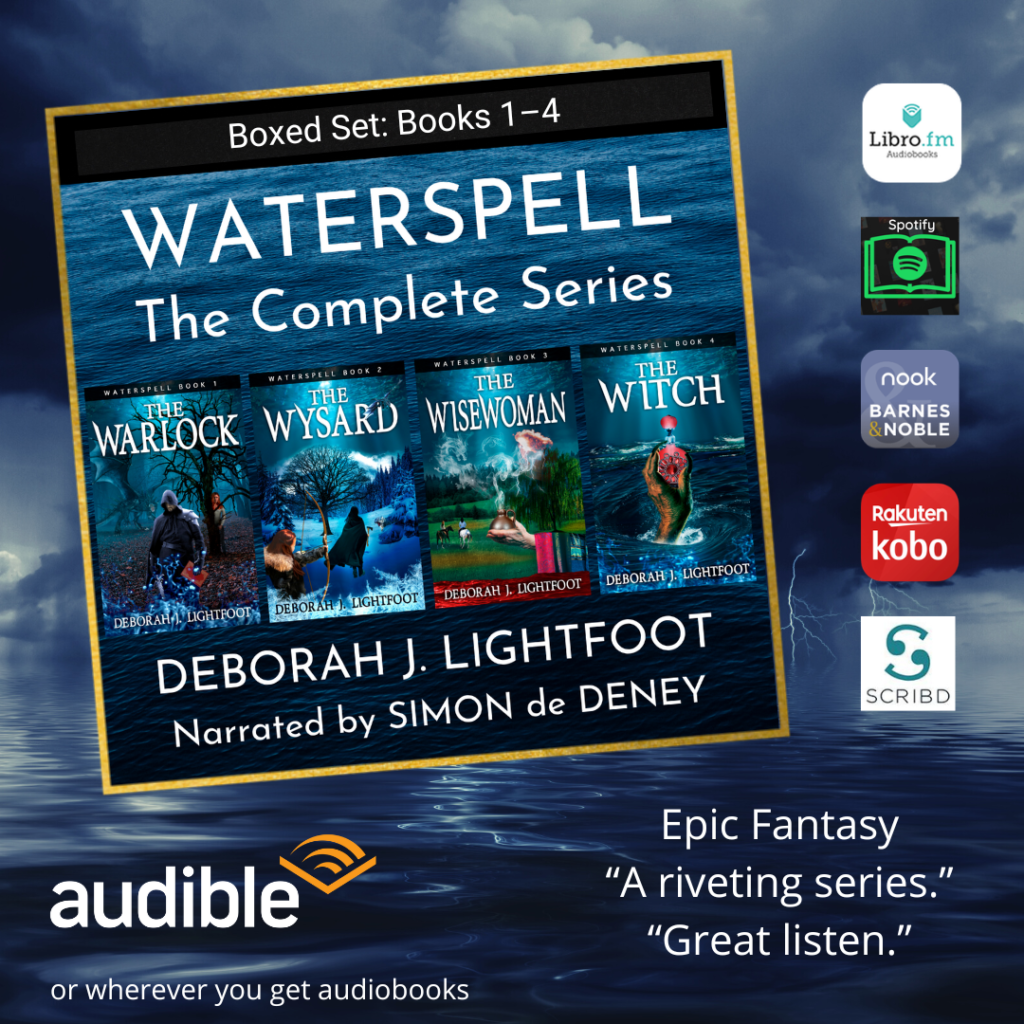
Canva is your friend. I’m not much of a photographer, and my aging Android phone doesn’t take especially good pictures unless the scene is perfectly lit. To get around that deficit, I use Canva heavily. I’ll spend an entire day creating Instagram posts at Canva, using the covers of my books and incorporating the nice reviews that I quote or screen-shoot from Amazon, Goodreads, etc. Creating Bookstagram content can take quite a lot of time, but I enjoy playing with designs at Canva, seeing how creative I can get. (Pictured is one of my recent designs, to promote the new Waterspell audiobook.) For me, Canva and Bookstagram together have become a fun way to showcase a different side of my creativity. If the words aren’t flowing during a writing session, I can go to Canva and play with pictures, and still feel like I’m being productive.
Mix it up. My pattern is to alternate promos of my own books with quotes from famous authors, or writing-related memes, or the occasional review that I’ve written for somebody else’s book or audiobook. Over the course of years, I filled thick notebooks with admirable examples of other people’s writing, or with the wise words of established authors. Those notebooks have been a rich source of inspiration for my bursts of creativity at Canva. My Bookstagram followers always respond warmly to the quotes I share. Every writer needs a regular shot in the arm, an almost daily reminder that what we do, does matter. And that we’re not alone. Even famous authors have bad days and get one-star reviews or draw the ire of book-burners. Hardly a day goes by that I don’t see something inspirational on Bookstagram, something that validates me as a writer. The writers and artists who are active there support each other, celebrate each other’s successes, and commiserate with the setbacks.
Once a day is plenty. There seems to be a general consensus among Bookstagrammers that it’s poor form to post more than once daily. Which suits me fine. Only on rare occasions do I violate that unwritten rule. Many Bookstagrammers post only weekly, or 2–3 times a week.
Block the spammers and bots. Newcomers to Bookstagram are instantly deluged with “Promote it on” scams. Every one of those fake accounts uses the same wording — “Promote it on” — typically followed by some variation of “Writers Heaven” or “Writers Paradise.” (The bots aren’t imaginative.) To fend them off, go into Settings, find Privacy & Security, find “Edit comment settings,” and find Comment Filtering, where you can list Hidden Comments. There, paste the following list of terms that the scammers use. You’ll need to add new terms to the list from time to time, as the scammers tweak the wording (“Writers Heaven” becomes “Heaven of Writers”). As one of your first steps, however, when you create your new Instagram account, put the following terms in your “Hidden Comments” list, and you’ll vastly reduce the amount of junk that floods in from bots and scammers. Eventually, as they figure out you’re not going to pay them to “review” your book, the scammers move on to more gullible writers.
As other thoughts occur, I may add to this post. For now, however, those are my main bits of advice for Bookstagram newcomers. I believe you’ll find, as I did, that it’s a welcoming community. Most of the writers and readers who are active on Bookstagram will follow you back, if you follow them. That reciprocity makes it fairly simple to grow your followers, in very little time, from zero to hundreds or even thousands.
I’ve been fairly selective about who I follow, being mostly interested in connecting with readers who might enjoy my books, and also with writers who work in my genre: traditional fantasy. I don’t follow many writers of urban fantasy, for instance, because I’m not trying to reach that specific audience. What works for them, in the way of promotion or reader engagement for instance, won’t necessarily apply to my efforts. From authors of epic or high fantasy, however, I’ve picked up many useful tips. I’ve learned about tropes and book blurbs and keywords. I’ve learned about online fantasy map generators, which is a new skill I really want to master.
In turn, I’ve shared what I’ve learned about cost-effective book promotion. Pretty much the only time anyone reads this blog is when I share something on Instagram about my book-promo efforts, and I invite my IG followers to learn more at my blog. That’s when I get eyes on posts such as Book Promotion Sites: Ranked and its followup, Book Promo Overview. I’m glad to know that other writers are benefiting from my experiences in the often predatory and potentially expensive world of book marketing.
If you’re an author on Bookstagram, I’d love to hear from you. Please drop your comments in the box below. I have a huge amount to learn about that platform, and I welcome the advice of more experienced Bookstagrammers. Please comment, too, if you’re just getting started. I’ll do my best to answer your questions, or to refer you to more authoritative resources.
April 21, 2022: The 4-in-1 book bundle hits the stores! Before I had my first cup of coffee on Release Day, I was checking the downloads on my Kindle and Nook to be sure the formatting had survived the trip through cyberspace. Especially the complicated Table of Contents that I struggled with, before finally figuring out how to use Word Styles to achieve the hierarchy needed to list each individual book with all of that book’s chapters as subheadings. Evidently I was successful: The TOC in every edition looks good and makes logical sense.
Now I wait for ratings and reviews to (hopefully) appear. I’m especially interested in the results of my Goodreads Giveaway of 100 Kindle copies: Will that giveaway generate the new reviews I’m hoping for? Fingers crossed that most of the people who entered the giveaway are actual readers of epic fantasy. Past experience, however, tells me that at least some of the entrants (and therefore, some of the winners) are pirates who only want free books that they can turn around and sell under the table. It’s a shame that Goodreads attracts so many unsavory characters. Between its trolls and its thieves, Goodreads remains a sketchy proposition for authors, though readers seem to find it useful for tracking their To-Be-Read lists. Here’s hoping that my newest giveaway produces results that will raise my admittedly low opinion of Goodreads.
Far more rewarding (and fun) has been my experiment in offering ARCs (advance reader copies) at NetGalley. Going through a co-op made NetGalley affordable. And so far, I’ve been very pleased with the quality of the reviews The Complete Series has received there (excerpts pictured above and below). I’m thinking of trying NetGalley again to pull in reviews for the forthcoming audiobook edition.
Release Day always feels anticlimactic, after the flurry of pre-release promotion. I’ve done what I can to let people know there’s now a boxed set, and the 4-in-1 bundle is the easiest, slickest, most convenient way to experience the world of Waterspell. I hope readers find it and love it.
Where does this leave me? Besides tired? I’m truly worn out from this flurry of publishing and promoting. The end of all this effort, however, is in sight. Before too much longer, I will log off of social media; ignore this website (as I have often done in the past); and settle down to WRITE something new! The ideas are bubbling. I’m scribbling notes, in between the Instagram posts and my YouTube uploads. What a joy it will be to discover the story that arises from those scribblings! I was meant to write, not to spend all of my time waving a book over my head, asking people to “Buy this, please!”
Once upon a time I belonged to an in-person writing critique group. The group gave me valuable advice, and I benefited from participation in it. But times changed, and our lives changed, and the group drifted apart, gradually breaking up, or reformulating itself with new members in a different meeting location. I ceased to participate.
These days, I get feedback via email and text messages from my beta readers and reviewers. I also try to engage with other writers on Goodreads and Instagram. Writing is a lonely profession, but it’s not good to work in too much of a vacuum. Even the most introverted among us need to interact with our peers.
It has been my pleasure recently to talk shop with Martin Dukes, author of the Alex Trueman Chronicles. It turns out that Martin and I have followed similar paths with our respective series: we were both away from our work for 10 years.
Coming back to a story after such a long break presents special challenges. I’m sharing our Instagram conversation here, for what it reveals about the issues involved and the concerns we both have as “long-haul authors.”
martin.dukes.wildest.dreams commented: Well done for writing four. How did this work for you? Has there been an obvious evolution in style during the series as you find your way with them? (Just going to Amazon now to get the first one ☺)
booksofwaterspell Thank you! I deeply appreciate your support and your interest. Books 1-3 of Waterspell are really the beginning, middle, and “end” of one continuous story. The new Book 4 is a coda, set five years after the events of the original trilogy. I’m not sure I would recommend that structure: A few readers have been really annoyed by Book 1’s cliffhanger ending. “Golly,” I think when a reader gets angry about it. “I’m giving you Book 1 for free, and several reviews have mentioned that it’s not a standalone, so why the outrage?” I guess I’m so accustomed to fantasy series that go on and on, it never occurred to me that readers would bristle at Book 1 ending on a cliffhanger. As to an evolution in style: I definitely became a more efficient writer. Rereading Books 1-2, I can see that they’re wordy in spots, and draggy in spots. Both would have benefited from a more ruthless paring than I gave them. By Book 3, I was writing more concisely. Partly, I imagine, because the scene had been thoroughly set (and described!) in Bks 1-2. But also because my style did evolve as I continued the saga. Many readers have commented that the series gets better as it goes. Oftentimes it’s the other way around (great first book, disappointing sequels) so I’m happy when readers say that I’ve avoided that trap, at least.
martin.dukes.wildest.dreams I’m surprised that anyone would object to your Book 1 ending on a cliff-hanger, unless it was not already apparent that this was the first in a series. From a writer’s point of view I’m sure such a device is useful in encouraging the reader to move on to Book 2 and a very normal strategy. TBF I could only see one such comment and your other reviews are universally enthusiastic. It’s constantly surprising how some reviewers will settle on one relatively trivial factor and use it as a yardstick by which to condemn the work as a whole! I’m interested to see that you recognise an improvement in your own writing style during the course of the series. I suppose sticking at it and writing them books in quick succession would help with regard to consistency. In my own series there was a gap of about 10 yrs between Books 2 and 3. I have tried very hard to keep things consistent but I’m sure readers will let me know if I haven’t! Did you likewise find that your characters matured and changed over time? (that is, assuming that some of the characters persist from book to book). For my own part, and since a central character is key to the series, I felt that there was a very real maturation as he aged with experience and as I came to know him better over time. Anyway, I wish you all the best with the series, which is evidently highly regarded and well-received.
booksofwaterspell A 10-year gap for you, too, huh. I’m working with the same: My original trilogy 2011-12, now the sequel in 2022. There’s a tension, I think, between achieving consistency but within a framework of growth, for both writer and characters. Like your main character, mine has matured, and her emotionally damaged “significant other” has (mostly) healed. One of my beta readers asked why I didn’t start Book 4 exactly where Book 3 ended (Bk 4 begins five years later). I replied that it wasn’t possible to pick up the story exactly where I’d left it. After my life took a sharp turn during those years, I wasn’t the same person who had written the original trilogy. My characters had also evolved. But I know those people and their story so well, I didn’t have as much trouble writing Book 4 as I thought I might. (Took me eight drafts, but that’s about right.) My beta reader commented: “Rereading the series, I realized your writing really hit its stride with the 3rd book. Not that there was anything wrong with the first two, but the 3rd had an ease about the writing. You’ve maintained that with this book.” I was relieved by her feedback. She confirmed that I’d achieved both some consistency and some growth, which is what a series should have, IMO. Regarding the grousing about Book 1’s cliffhanger: There’s more griping on Goodreads than on Amazon. But I served the story the best I could. If some folks dislike the structure, they have plenty of other books from which to choose!☺I’m looking forward to reading A Moment in Time. It’s up next in my TBR pile.
“It’s constantly surprising how some reviewers will settle on one relatively trivial factor and use it as a yardstick by which to condemn the work as a whole!” —Martin Dukes, author
It’s nearly January! I’m champing at the bit, ready to start the New Year with my long list of new publishings and refreshed publishings:
1. NEW Waterspell Book 4, both ebook and print, becoming available for pre-orders in January. 2. REFRESHED Books 1-3, ebook and print editions, going up at Amazon, Google, Smashwords, Lightning Source, etc. 3. NEW Complete Series Boxed Set, Waterspell Books 1-4, available for pre-orders in March, I think. 4. NEW Complete Series Audiobook Boxed Set, to be published in Spring 2022.
If I was better at social media, I would know just how to tease the new Book 4 with a tantalizing and intriguing Cover Reveal. Even without that, though, I’m pretty pleased with the success of my marketing efforts for the series-starter, Book 1: The Warlock. It has made it onto an Amazon Best Seller list.
To feed my need to be doing something ahead of January, which will be a flurry of publishing activity, I’m using this week to make my lists and check them twice, ensuring that every file and graphic is in readiness for January 1. I seriously doubt I can wait any longer than that, to get Book 4 out there and then begin the painstaking process of refreshing the Original Trilogy, in every edition and format. I’m committed to publishing wide, but it does take organization and forethought to ensure completeness and consistency across multiple publishing platforms, booksellers, and databases:
The past 30 days have been highly productive and educational. I now have a much better idea, and a better plan, for spreading the word about the original Waterspell trilogy as well as the forthcoming Book 4 (and the forthcoming boxed set). My promotional efforts are paying off, and I’m learning what works and what doesn’t.
Today, November 18, with the official launch of Waterspell Book 4 just four months away (it should be available for pre-orders in only two months, on January 18), I’ll try to summarize what I’ve I learned.
BookBub vs. BookRaid
Hands down, BookRaid.com is better! I’ve found that BookBub is overrated and overpriced. Comparing my continuously-running BookBub ads with my one-day BookRaid ad:
• BookBub got 273 clicks at a cost of $160 = $0.58 per click • BookRaid got 715 clicks at a cost of $62 = $0.086 per click
That’s right: A one-dayBookRaid ad attracted nearly three times as many clicks, and cost me less than 9 cents per click. BookRaid advertising maxes out at $60. No matter how many clicks an ad gets, the advertiser will not be charged more than $60. It’s a Canadian company, and my credit card charged me $1.80 foreign transaction fee, so the actual, final cost came to $61.80. Divided by 715 clicks, however, that’s less than 9 cents per click, compared to the nearly 60 cents per click (!) at BookBub. What a bargain BookRaid is!
Particularly in light of the great results. My BookBub ads had been running almost continuously for weeks, and they were barely moving the needle at Amazon. In fact, almost no Amazon (Kindle) customers were even clicking on my BookBub ads; those ads mostly attracted Google Books and Apple-Canada readers. (I love my Google Books and Apple-Canada readers! Don’t get me wrong. It’s just that Amazon rankings count for so much in the crazy world of publishing.)
#147 Fantasy Adventure #289 Sword & Sorcery #305 Epic Fantasy
But then on November 7, following my one-day BookRaid ad, my Amazon rankings were:
#446 overall #4 Fantasy Adventure #8 Coming of Age #8 Sword & Sorcery
The numbers also improved at Barnes & Noble: from 124,953 before BookRaid, to 71,283 after.
ManyBooks and Fussy Librarian
Pleased though I was with those numbers, I wasn’t done experimenting. I scheduled ads for the very next Saturday, November 13, benefiting from discounted prices at both The Fussy Librarian ($39, regularly $49) and ManyBooks.net ($19, regularly $29). With those promotions running simultaneously, I can’t say which was the most effective, but together they brought me great results. That Saturday morning, Book 1 was ranked #3256 at Amazon: #26 Fantasy Adventure, #51 Sword & Sorcery, #52 Epic Fantasy.
That day and the next, those numbers climbed:
Sales rank on November 13 (left, with ManyBooks and Fussy Librarian promotions running), and on November 14, the morning after those promotions.
My conclusion? Stop wasting money on ineffective, overpriced BookBub ads, and direct my promotional dollars instead to the lovely folks at BookRaid, ManyBooks, and Fussy Librarian.
Goodreads and Other Social Media
After taking Alessandra Torre’s free Goodreads webinar, I’ve got a somewhat higher opinion of Goodreads. I’ve tried to implement Alessandra’s great advice about interacting effectively and efficiently on that platform. Some of her advice is:
• Leave reviews for books you love (those you can honestly 5-star) • Like/comment on other reader reviews of those same books • Mark your current read as “Reading” • Leave your own review of your own books (no star rating, just your comments) • Like/comment on the 5-star reviews that readers have given you • Share a Goodreads review on your other social media
After doing these things, I’ve definitely seen more engagement with readers at Goodreads. To my absolute delight, several new readers have gifted me 5-star reviews there. These are the first new interactions I’ve had at Goodreads in ages. My effective promotion (via BookRaid, Many Books, and Fussy Librarian), combined with my more enthusiastic Goodreads participation, seems to be attracting new supporters to my cause. I’m deeply grateful. ♥
These 5-star ratings appeared at Goodreads after my November 6 BookRaid ad and my November 13 promotions at ManyBooks and The Fussy Librarian.
These new 5-star ratings have raised my overall numbers at Goodreads to 3.97. Alessandra Torre said the average rating there is 3.5 stars, so I’m feeling good about being “above average.” ↑ Goodreads has a reputation as troll central: too often, there seems to be more emphasis on savaging a writer than on appreciating the time and effort it takes to write a book. With Alessandra’s blessing, I’ll try harder to boost and appreciate the work of my colleagues, to share the love in this crazy publishing free-for-all.
As for my other social-media efforts:
Instagram is working well. I’m connecting with readers and authors there. So far it hasn’t brought me any new reviews (that I know of), but I enjoy interacting with Bookstagrammers.
My Facebook author page isn’t worth the space it occupies. Hardly anybody sees it.
My personal Facebook profile is reserved mostly for my private life, but when I get good book news, I’m thrilled to share it with my friends and feel their love.
The Facebook groups in which I’ve been active are getting less of my time now. They’re either not focused enough on my genre, or they’re actively hostile to authors’ promotional efforts. The latter has surprised me.
What’s Next?
All that I’ve learned this past month has helped me refocus my efforts. It dawned on me that, instead of spending my entire marketing budget on individual Book 1 and Book 4 promotions, I should instead plan to vigorously promote the next big thing on my to-do list, which is the boxed set of the complete Waterspell series.
With that future marketing in mind, I’m taking a break from paid advertising for the next six weeks or so. Gonna save my money for a big push in early 2022—especially now that I know what works to move the needle at Amazon.
Book 1 Amazon rank 18 Nov 2021
Even today, five days after my dual ManyBooks/Fussy Librarian promotion, Waterspell Book 1: The Warlock is well ranked at Amazon. And now it’s got 39 ratings: one more than yesterday. People are finding it and reading it! I am feeling much encouraged. It may indeed be possible to relaunch this series, after Life with a capital L sidelined me for too many years.
Four weeks have flown by in a swirl of promotional activities. Now it’s time to take stock and decide what’s working, and what needs adjusting.
Discounting. Making Waterspell Book 1: The Warlock free in all ebook formats has definitely raised the book’s profile. At one point, it ranked about #1,200 in the Kindle store, and around #46 in Fantasy Adventure Fiction. Alas, I did not screen-shoot those lofty numbers, so now I can’t prove what I saw. As of today, however, the book is still ranking respectably at Amazon (as pictured). Its sales rank at Barnes & Noble also improved quite a bit. There’s no doubt: making it free has made Book 1 more visible.
Reviews. Free ebooks have NOT yielded new reviews, however. I’m kinda gobsmacked over the difficulty of getting readers to post reviews. Even giving away paperback copies to potential reviewers has garnered only one new review in a whole month. It’s a reality check, for sure, regarding the vast numbers of books that are available to readers, and the vast numbers of authors who are clamoring for the attention of those readers.
Exploring additional avenues to get reviews, I’ve signed up at StoryOrigin. There, I posted a sample as a Reader Magnet, and my offer of a free review copy has been accepted by two readers so far. Also, I’ll be participating in a group promo for Portal Fantasy books, Dec. 1–31.
Just today, I entered Waterspell Book 1 in a monthly book giveaway sponsored by Reader Views. Am waiting to hear when the giveaway will be scheduled. It’ll be in time, I hope, to help with next year’s planned Book 4 publicity.
Bookstagram. This platform has been encouraging. I’m connecting with other authors, and with reviewers and book bloggers. Two readers have accepted my offer of a free review copy in exchange for honest reviews. Those reviews have not yet been posted, leaving me to wonder whether they will be. Fingers crossed.
BookBub ads. Mixed results here. I’ve tested various graphics. All of these (below) have attracted some clicks, but none has performed spectacularly. For my next month of advertising, I’m switching to Freebooksy.
Blog Tours. Going on blog tours was the best way I got reviews when the Waterspell trilogy was first published. I’m thinking it may be time to investigate what’s available these days. On Bookstagram, I follow TBR and Beyond Tours. Not sure they’re a perfect fit, but I’ll look into them further. I’ve bookmarked several other possibilities at The Book Designer.
Those of you who occasionally read my blog posts (thank you! I love you!) have probably figured out, by now, that I use this space for thinking out loud. It’s my planning area. Without my posts on “discoverability,” I’d never be able to keep track of plans made, plans executed, or plans adjusted. All of this marketing work is squeezed into the hours when I’m not actively writing—or formatting.
On top of everything else, I’m repaginating the paperback editions to skinny-up the print books a tad (in light of current printing and shipping costs) and to update the copyright and About the Author pages. Scattered about my house are PDFs of Books 1, 2, and 4, with Book 3 yet to be repaginated. The Book 4 manuscript is out with my final beta reader, I’m busily promoting Book 1, and I’m trying to be a regular Bookstagrammer, while not wholly neglecting Goodreads and Facebook. The days are just packed! And now I’ve added StoryOrigin to my online efforts. I can’t keep this up forever. About a month after Book 4 is published, I’m going to collapse and sleep for three days.
Sitting on a bookshelf over my computer desk, for several years, has been a spiral notebook that I filled with quotes and notes from the books I was reading while writing the first three books of Waterspell. I bought the notebook in Mexico, where my late husband and I were living at the time, and where the original Waterspell trilogy was largely written. Our house on Lake Chapala, south of Guadalajara, made for the perfect writer’s den. I was insulated from my formerly too-busy life north of the border, and could devote myself full-time to the creative act of writing fiction, and to reading widely in support of my work.
Once the original trilogy got published, I seldom or never looked at the notebook that I’d filled with pertinent or inspiring notes and quotes. After getting on Instagram, however, I pulled the notebook off the shelf and, paging through it, discovered that I had created a wonderfully diverse archive of readily Instagram-able thoughts and sayings.
They have inspired me to feverish sessions at Canva, where I’ve upgraded to a Pro account to have access to ALL of the pretty pictures. I’m having a great time creating square-shaped graphics that feature quotes gleaned from my jam-packed notebook. On Instagram I’m alternating such quotes with excerpts from readers’ reviews of Waterspell, and the strategy seems to be working. I’m connecting with readers, reviewers, bloggers, and other authors much faster and more easily than I’ve ever managed to do on my largely useless Facebook author page.
Here’s a sample of the Author Quotes that I’ve taken from my old Mexican notebook and transformed on the Canva interface into post-worthy graphics:
And here are some of the graphics I’ve made to feature excerpts from readers’ reviews:
I am deeply grateful to the readers and bloggers who gave Waterspell such wonderful reviews upon the books’ original publication. I’m grateful to Canva for making it so easy and such fun to feature these review snippets as attractive graphics. I’m grateful to Bookstagram for giving me a place to post my Canva creations. Canva and I, and my books and Instagram, are jelling together quite well these days. Giving me hope that I may yet break through the static and bring my work to the attention of new readers, upon the publication of Waterspell Book 4, and to new listeners as well, when the long-in-progress audiobooks are finally released.
When books meet tech the right way, the results can be beautiful.
“I absolutely loved all four books! You kept your storyline throughout the four books brilliantly. The characters were all genuine and relatable.” —Carol, Goodreads
“In this four-book saga, the author has created an epic fantasy world full of magic, danger, romance, and travel through time and space. The characters are vivid and complex. This is a most enjoyable read for fans of fantasy and fine writing.” —Shirley, NetGalley
“An entertaining, fast paced, and well-plotted fantasy series. The world building is fascinating, and the characters fleshed out. Highly recommended.” —Anna Maria, NetGalley
“Jane Eyre meets Beauty and the Beast. Amazing story, very original. Great series.” —Emma, Amazon UK
“A riveting series. Well written, excellent world-building with an engaging plot in each book and well-developed characters. I was gripped right from the start with twists I didn’t see and unpredictability.” —Aria, NetGalley
“I was hooked instantly. I willingly gave up sleep and could not wait to get up to read more. I’m reading the whole series, and absolutely loving it.” —Sarah, Amazon
“I was HOOKED. I read until 3 am two nights in a row to finish this. The magic system is unique and the characters are as morally gray as they come.” —Megan, Goodreads
“A great read that features world building with drama and magical characters. Highly recommended.” —Neil, Amazon
“A must-read for fantasy enthusiasts who enjoy immersive world-building, well-developed characters, and a storyline that seamlessly blends magic and human emotion.” —Dalton, NetGalley
“Lightfoot has a sure touch with regard to characterisation. Each of her characters has their own authentic and convincing voice. Narrative, description and speech are exceptionally well-balanced.” —Martin Dukes, author of the Alex Trueman Chronicles
“An extraordinary book, four in fact! I read these over a five-day period and found the storytelling fantastic. See for yourself!” —Michelle, NetGalley
“Addictive epic fantasy, with drama and adventure. I binged through the books, eager to see how the story unfolds. Great book. 5 stars.” —Di, NetGalley
“Complicated characters, plot twists, romance, adventure, and magic — all written in a voice that immerses you in a fantasy world both foreign and familiar. Get the box set because you won’t want to leave this world.” —Beck Digs It, Amazon
“Captivating. I loved this series from beginning to end. Complex characters who mature through the series and unexpected plot twists kept me reading far too late into the night.” —Amy, Amazon
“Such a joy to narrate this. It didn’t feel like work. The story and characters take flight so naturally and then soar.” —Simon de Deney
You won’t want to leave this world.
Castles in the cornfield provided the setting for Deborah J. Lightfoot’s earliest flights of fancy. On her father’s farm in Texas, she grew up reading tales of adventure and reenacting them behind ramparts of sun-drenched grain. She left the farm to earn a degree in journalism and write award-winning books of history and biography. High on her bucket list was the desire to try her hand at the genre she most admired. The result is Waterspell, a multi-layered, intricately detailed fantasy about a girl and the wizard who suspects her of being so dangerous to his world, he believes he’ll have to kill her … which troubles him, since he’s fallen in love with her. Deborah is a professional member of The Authors Guild. She lives in the country near Fort Worth, Texas.
Magic, mystery, murder, and romance. Waterspell: An intricate save-the-world fantasy adventure with complex characters, cosmic calamities, and the gothic sensibilities of Jane Eyre.
Mix environmental fantasy with magic, mystery, and a little slow-burning romance, add dystopian undercurrents, and that’s the Waterspell series—a cross-genre story with too many layers for a single label.
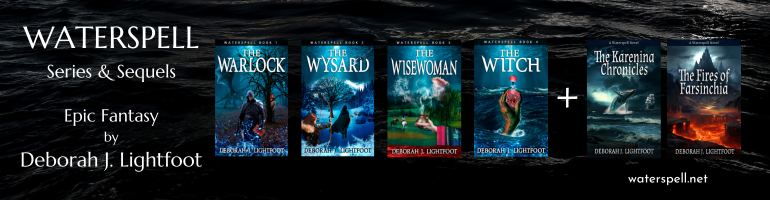


 efocus my efforts. It dawned on me that, instead of spending my entire marketing budget on individual Book 1 and Book 4 promotions, I should instead plan to vigorously promote the next big thing on my to-do list, which is the boxed set of the complete Waterspell series.


 Sitting on a bookshelf over my computer desk, for several years, has been a spiral notebook that I filled with quotes and notes from the books I was reading while writing the first three books of Waterspell. I bought the notebook in Mexico, where my late husband and I were living at the time, and where the original