This is a collection of things I want to keep, gathered from old files and past posts, starting with an “Awesome Indies Discovery” blog hop hosted by Mary Maddox:
Origins
I wrote much of Waterspell while living in the tropics in a house that was open to the breezes of soft summer nights. Often I worked late, gripped by a writer’s high, my fingers flying over the keyboard while the world slept. Vaguely I would catch the hoots of owls and the fragrances of night-blooming flowers wafting in on the breeze, but I wasn’t really occupying the same universe as the house that held me. On those magical nights, I was living with—and in—the characters of my medieval fantasy. I saw through their eyes, thought their thoughts, and felt their anguish. I didn’t merely sympathize with their pain: I felt it.
My writing became an out-of-body experience as my consciousness melded with my characters. Nothing existed in those moments except my pulse-pounding rush to capture not only their words and actions, but also their deepest secrets. I saw behind their masks. I knew things they’d never told anyone—hidden things they had not fully acknowledged even to themselves.
In the small hours of the night when exhaustion finally drove me from the keyboard, I sometimes found myself thinking, as I headed for bed, that I would like to read more of the story which had so riveted me. Then I would realize that I couldn’t read more of it until I had written it. The experience was like being split in two. The hours I spent out of my body, my mind at one with my characters, made for confused dreams as my essence struggled to leave the world of Waterspell and return to Earth.
When at last the writing was done and I could declare the trilogy finished, I cried a little to be parting from my characters. They were real to me. For the better part of 16 years they had lived in me, and I in them. We had spent a life together.
But now they were moving into a wider realm. The books were published, and readers began responding. I’ve been deeply gratified by the emotional connections that many readers have forged with these idiosyncratic characters of mine. Reviewers have called them complicated, original, mesmerizing.
Beyond Character: Going Deeper
As thrilling as it is to see my creations become real in readers’ imaginations, I’ve now found myself hoping for reviews that will give equal time to the story’s deeper themes.
One of those themes deals with the human need to belong. We all want to fit in; we want a place and a community to call our own. My protagonist, a young misfit named Carin, is homeless and rootless as the story begins. Her quest is to find the place where she belongs. Or more accurately, her challenge is to make a place for herself in a world where she does not really fit.
That’s one subtext of the story. Going deeper, camouflaged amongst the underpinnings of the trilogy, is a commentary on environmental exploitation, ecological devastation, and Nature’s powers of regeneration, if we’ll only give Earth the chance to heal. That theme is nuanced enough that I wouldn’t expect most readers to pick up on it until late in Book 2. And even when this subtext is more fully explored in Book 3, it’s far subtler than the adventure, mystery, and romance of the trilogy’s surface layers.
Even so, I’m hoping to connect on those deeper levels with readers who enjoy a good fantasy adventure, but who also want more from a book than simple entertainment. Come for the characters, love or despair of them as you will, but please know there’s more happening in the depths of Waterspell. On the surface, the story may seem medieval. Down below, however, it’s as contemporary and relevant as the latest natural disaster or planetary catastrophe to strike our Mother Earth.
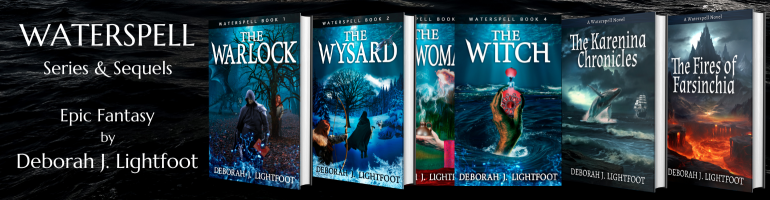
If you’re interested in environmental literary fiction or you like characters who’ll keep you up nights, I invite you to sample Waterspell Books 1, 2, and 3 at any online bookseller. The three books of the trilogy—The Warlock, The Wysard, and The Wisewoman—are the beginning, middle, and end of a continuous story, and best read as a set.
Beginnings
In the year 2000, I created my very first website for my fantasy books. Using WebExpress 4.0, I created an elaborate monster, complete with a purpose-bought Kells font for the headings and navigation buttons. It was very purple and bright green.

My site was chock full of links. Somewhere I’d read that a website rises higher in search results if it has lots of links. So I linked like crazy, and of course found it impossible to fix all the broken links that invariably result from an ever-changing Internet.
I worked on it for years, adding sidebars and other interesting tidbits of information—interesting to me, if to no one else. I watched as the World Wide Web added a vastness of bells and whistles, and computer monitors became wider, and my carefully constructed site began to look pitifully dated (even with its Planet Doom “Cool Site” Award). I eventually moved on to a new, more modern-looking site hosted by the Authors Guild, but I left my old site up because it represented hours, days, months, years of work. I couldn’t just delete it.
But Earthlink could. While my back was turned and my attention was elsewhere, Earthlink deleted the whole thing, with nary a by-your-leave.
I, however, am a packrat. Not quite a hoarder, but a keeper of digital files from every computer I have ever owned. I have two standalone hard drives, plus a large collection of thumb drives, all full of stuff that “I might need some day.”
On one of the hard drives I found the 2006 version of my old website. Is there anything absolutely vital in it? To the world at large … no. But considering that I started writing Waterspell in 1996 and the third book of the trilogy came out in 2012, that old website held the first 10 years of what became a 16-year effort.
Therefore, as a walk down memory lane for me, and as a possible source of inspiration for interested readers or writers, I have excerpted the more meaningful sidebars and passages from the Website That Was. I hope you enjoy these X-Files (X in the sense of “obliterated” or “annulled”).
Favorite Quotes
“Storytelling reveals meaning without committing the error of defining it.”—Hannah Arendt, philosopher
“The goals of science and magic are identical: the unlocking of the mysteries of Nature.”—Michael Patrick Hearn, Introduction to The Annotated Wizard of Oz. W.W. Norton, 2000
“Every writer is a skater, and must go partly where he would, and partly where the skates carry him.”—Ralph Waldo Emerson
“Like heat-resistant gloves, imagination gives us writers the ability to touch subjects from our life, or the lives of those we love, that would otherwise be too painful to handle. Often this happens at a subconscious level, so that the writer is convinced that what she is writing is pure fiction. It is only afterwards that she realizes that, through her understanding of the character she created, she has learned compassion for those who were the unrecognized models for the character—and hopefully, for herself as well.”—Chitra Banerjee Divakaruni, author of The Unknown Errors of Our Lives
“It’s lovely to know the world can’t interfere with the inside of your head.”—Frank McCourt, Angela’s Ashes
“It has always been a tenet of writing that in order to write well and powerfully, you have to descend into yourself, look honestly into your black heart, write what you see there and thus know to be true.”—Bruce Weber, The New York Times
“The foundation of good fiction is character-creating and nothing else. … Style counts, plot counts; originality of outlook counts. But none of these counts anything like so much as the convincingness of the characters. If the characters are real the novel will have a chance; if they are not, oblivion will be its portion.”—Arnold Bennett
“In steelmaking, a blast furnace must be heated for weeks before it is hot enough to forge steel. Getting yourself into the writing mood is like that furnace—you’re better off not to let it cool down.”—Ayn Rand
“I’m a slow writer … I worry about searching and tracking down the right word, whether it emerges from the dictionary or from a deeper place within myself. One of the things I’ve had to do over the years is accept my pace, even though there’s a tremendous pressure that’s brought to bear on a writer in America to produce and to produce quickly.”—Paule Marshall, novelist
“Process is the great happiness. It takes us up and the time passes like the wind and we still have time for consideration and reflection. It is the great bargain in satisfaction, while the highly advertised Achievement brings a certain emptiness since it is very hard to experience or even believe.”—Mike Nichols, director
“The only safe thing is to take a chance. Play safe and you are dead. Taking risks is the essence of good work, and the difference between safe and bold can only be defined by yourself since no one else knows for what you are hoping when you embark on anything.”—Mike Nichols
“Writing which achieves well the thing it sets out to do and doesn’t cheat or be cynical or a slave to fashion is still the key.”—Caroline Dawnay
“An affinity for risk, danger, mystery, a certain derangement of the soul; a craving for distress … the predilection for insomnia” —that describes a writer, according to Joyce Carol Oates in The Faith of a Writer: Life, Craft, Art
Why write? “… the afterglow can last for years if the work is published and other people profit from it. The lasting pleasure is not in their praise but in your knowledge that you have contributed something of value to the culture from which you derive your being.”—Ellen Gilchrist, The Writing Life
“You can’t write seriously without reading the greats in that peculiar way that writers read, attentive to the particularities of the language, to the technical turns and twists of scene-making and plot, soaking up numerous narrative strategies and studying various approaches to that cave in the deep woods where the human heart hibernates.”—Alan Cheuse
“Ignorance of English vocabulary and grammar is a considerable liability to a writer of English. The best cure for it is, I believe, reading.”—Ursula K. Le Guin, “‘Where Do You Get Your Ideas From?'” Dancing at the Edge of the World: Thoughts on Words, Women, Places (Grove Press, 1989)
“I believe the road to hell is paved with adverbs, and I will shout it from the rooftops.”—Stephen King, On Writing: A Memoir of the Craft, 2000
“The scariest moment is always just before you start. After that, things can only get better.”—Stephen King, On Writing: A Memoir of the Craft
“The trouble with the world is that the stupid are cocksure and the intelligent are full of doubt.”—Bertrand Russell
“Listen carefully to first criticism of your work. Note carefully just what it is about your work that the critics don’t like—then cultivate it. That’s the part of your work that’s individual and worth keeping.”—Jean Cocteau
“If you write (or paint or dance or sculpt or sing, I suppose), someone will try to make you feel lousy about it …”—Stephen King, On Writing: A Memoir of the Craft
“Condemnation is lack of imagination, when one cannot suggest something better.”—Theodore Zeldin, An Intimate History of Humanity. HarperCollins, 1994
“To me, the essence of editing lies in helping the author say what he wants to say in the way he wants to say it.”—Betty Ballantine, legendary SF editor
“There used to be the shared conviction that the author’s job was to write masterpieces and that the publisher’s job was to publish masterpieces. I have known editors and publishers who believed it. They are all dead.”—Matthew J. Bruccoli, author and critic
“To have a new vision of the future, it has always first been necessary to have a new vision of the past.”—Theodore Zeldin, An Intimate History of Humanity
“We must have a past to make a future with … To make a new world you start with an old one, certainly.”—Ursula K. Le Guin, Dancing at the Edge of the World: Thoughts on Words, Women, Places
“What to do with too much information is the great riddle of our time.”—Theodore Zeldin, An Intimate History of Humanity
“He spoke of Life as the rainbow that brilliantly spans two mysterious silences, one of which is dawn and the other sunset. This flaming arc must end, as it begins, in pain, but, past the silence, and, perhaps, in even greater mystery, the circle must somewhere become complete and round back to a new birth.” —Myrtle Reed, Flower of the Dusk (1908)
Waterspell Plot Synopses
(Short version:) Carin, a homeless teenager, struggles to survive when a wizard decides she’s an expendable weapon in his fight to save his world from lethal alien plagues and the destruction of all native life-forms.
(Long version:) Teenage Carin has no memory of her childhood, no home to go to, and nothing to rely on but the whispered advice of a village wisewoman. When Carin takes that advice and goes searching for her past, she falls captive to a quick-tempered wizard named Verek.
Verek subjects her to a series of tests—some mundane and some magical—to discover who and what she is. No natural creature of his world could defy his enchantments as Carin does. What gives her the power to resist him? Where is she from? Did somebody send her?
As the answers come to light, Carin discovers that Verek plans to use her as an expendable weapon in a battle to save his world from biological devastation. If Verek’s scheme fails, a lethal epidemic will overrun his world. If his plan succeeds, the dangerous wysard who stole Carin from her childhood home on Earth will die.
So will Carin.
Nice Words from Readers
“Definitely captures interest … Carin immediately becomes an interesting POV character, with a nice sense of mystery surrounding her. Verek is intriguing as well. The plot is clear without being simplistic. The threat is tangible with a compelling sense of consequences. Intriguing that the danger isn’t simply the standard ‘gathering armies of mass destruction.’ A nice balance between the rustic sense of a medieval world and a voice that will be recognizable to the modern audience.”—Steve Saffel, Del Rey Books, SouthWest Writers Contest, judge of the Science Fiction/Fantasy Novel Category (2002)
“Beware—not of the Jabberwock but of the spell woven in this finely crafted tale of love and mysterious fantasy. The strong narrative is firmly grounded in research of period colloquialisms, folk beliefs, and foods, so while one is immersed in the adventure, one is also absorbing cogent historical details. Quite a satisfying read!”—K. B. Cotal, Teacher
Book Reviews I’ve Written
Frances Mayes’
Under the Tuscan Sun:
At Home in Italy
Reviewed by
Deborah Lightfoot Sizemore
Surprising one’s life
Shortly before my husband and I packed up and headed to Mexico in 1997, I discovered Frances Mayes’s Under the Tuscan Sun. Mayes’s memoirs of buying and restoring an ancient stone house in Italy proved to be one of those serendipitous finds that fills a need heretofore unrecognized. Just as I was beginning the greatest adventure of my life—full-time residency in a foreign country—there fell into my hands this beautifully written book by another who had taken the same kind of plunge, and for many of the same reasons.
In fact, with their purchase of a long-abandoned stone structure in Tuscany, Mayes and her husband jumped into deeper waters than Gene and I did. At least our house in Jalisco, Mexico, was fully modern and needed no restoration; we just moved in, plugged in, and started living the life we’d dreamed of.
Mayes, however, faced the nightmare prospect of a long-distance restoration: Italian workmen gutted and renovated their new multistory home during one long winter, while Mayes and her husband remained in San Francisco tending to their jobs as university professors. If you’ve ever had major work done to your house, you can imagine their near-panic as they tried to monitor and supervise the work by phone and fax from several thousand miles away.
The first half of Under the Tuscan Sun follows their adventures in restoration, a combination of comedy and tragedy as they wrangle with the emotional Italians to finally get the house they’d envisioned. If you like This Old House on PBS, you’ll love Mayes’s detailed account of work done, undone and redone.
My favorite part of the book, however, is the half in which she tells of touring the Italian countryside, discovering the out-of-the-way places that are within driving distance of their new home. If you’ve been to Italy or longed to go, you’ll eat up the chapters on Etruscan tombs, Roman roads, forest paths, churches great and small, high town walls with gates that once kept out hordes of Ghibellines and Guelfs, and narrow streets branching off of crowded piazzas.
And the food—for page after page, Mayes writes of shopping for fresh fruttas e verduras, cooking lavish meals for two and twenty, trying new recipes, and adapting to local ingredients the family recipes of her Georgia upbringing. Unless your tongue’s been cut out, your mouth will water at the glowing descriptions of Italian food. I hate to cook, and yet I photocopied several of Mayes’s simpler-sounding recipes to carry with me on twice-weekly trips to San Luis Soyatlan’s produce market. Why not attempt Italian cooking with Mexican ingredients? The two countries, after all, are not so far apart in latitude or culture.
The similarities between Mayes’s experiences in Italy and mine in Mexico drew me to this book as a nectar-filled flower draws a hummingbird. Mayes writes of “exploring the layers and layers of Tuscany and Umbria; cooking in a foreign kitchen and discovering the many links between the food and the culture—these intense joys frame the deeper pleasure of learning to live another kind of life. . . . life must change from time to time if we are to go forward in our thinking.”
Like Mayes and her husband, Gene and I felt “the desire to surprise our own lives.” We left behind comfortable predictability and sought to live another kind of life, one that brings daily adventures, surprises, and discoveries. For me, perhaps the most welcome change was the simplest: Like Mayes in her Italian rose garden, I in my airy Mexican house have reveled in “long days with birdsongs instead of the sound of the telephone.”
—First published in the Winter 1998 Friends News, a publication of Friends of the Fort Worth Public Library, Inc.
Stephen Hawking’s
Black Holes and Baby Universes
Reviewed by
Deborah Lightfoot Sizemore
A mind-stretching experience
Reading the works of Stephen Hawking is like listening to opera: I don’t understand everything that’s said, but I enjoy the experience.
Hawking, the brilliant theoretical physicist from England, surprised a lot of people (including himself) with the success of A Brief History of Time, published in 1988. The reissue of that book in an expanded and illustrated edition reminded me to pick up the sequel, a collection of essays titled Black Holes and Baby Universes. This later work differs from A Brief History in offering intimate glimpses of Hawking’s personal life and his struggle with Lou Gehrig’s disease.
Born in Oxford in 1942, Hawking grew up in Highgate, north London. His father was a medical researcher; his mother the daughter of a family doctor. Most of their neighbors were also scientific and academic people. “In another country they would have been called intellectuals,” Hawking writes, “but the English have never admitted to having any intellectuals.”
Though he describes himself as an unremarkable student, Hawking says he was always interested in how things operated and used to take things apart to see how they worked. “But I was not so good at putting them back together again. My practical abilities never matched up to my theoretical inquiries.” From the age of 13 or 14, he knew he wanted to do research in physics because it offered the hope of unlocking the secrets of the universe.
His decision to pursue a career in theoretical physics proved fortunate, for he had barely begun work on his Ph.D. at Cambridge when, at age 21, he was diagnosed with ALS (amyotrophic lateral sclerosis), or Lou Gehrig’s disease. Theoretical physics was one of the few fields of scientific research in which his condition would not be a serious handicap.
Hawking married in 1965, two years after he was diagnosed with ALS. While still in his twenties, and already confined to a wheelchair, he developed new mathematical techniques to theorize about conditions in the early universe. His work showed that there was a time in the past when all of the galaxies were on top of each other and the density of the universe was off the scale. This high-density state is called the “big bang” singularity.
Hawking is also famous for his work on black holes, which form when massive stars burn out and collapse in on themselves. The gravitational field of a collapsed star is so strong that light cannot escape but is dragged back. It is impossible for us to see such a star because the light it emits does not reach us; thus the name “black hole.”
I don’t pretend to actually understand everything Hawking writes about black holes, baby universes, curved space, the linked nature of space-time, or the possibility that the universe may have many alternative histories. For all of that, his writing is remarkably accessible. When I read his essays, I get a comfortable sort of feeling, as if I were listening to music. I do not need to analyze each note to enjoy an aria; the music’s cumulative effect is what counts. Neither do I need to fully understand Hawking’s ideas to enjoy his writing.
Readers who shy away from Hawking’s books because they think the material is beyond their grasp are missing some fine writing. They’re also denying themselves the pleasure of his dry British wit. I frequently laughed aloud at the jokes and anecdotes sprinkled through these essays. Black holes, Hawking ruminates, might be useful for getting rid of garbage or even some of one’s friends. The search for a grand unified theory (a “GUT”) that describes the universe and everything in it is a slow process because “it is too difficult to think up a complete theory of everything all at one go (though this does not seem to stop some people; I get two or three unified theories in the mail each week).”
Whether you’re working on your own theory of everything, or you thought “black hole” simply described a teenager’s bedroom, you won’t come away empty from an encounter with the boundless mind of Stephen Hawking. So go ahead—put on a Lohengrin CD and stretch out with Hawking’s essays. Space and time may never look the same to you again.
—First published in the Winter 1997 Friends News, a publication of Friends of the Fort Worth Public Library, Inc.