Tag Archives: writing process

“Where Do You Get Your Ideas?”

Every writer gets asked: Where do the ideas come from?

For many of us, the question is so unanswerable, we can only smile gently and deflect. Have you heard about the warehouse in Poughkeepsie where ideas can be had wholesale, a dime a dozen? (Wink, wink)

Seriously, most writers have no real idea where the ideas come from. Ideas well up from the subconscious, far below the level of awareness. More than once, as I’ve come awake in the morning, I’ve had the entire plot of a book running through my head. It’s a mad dash to the keyboard then, stopping only to grab a cup of coffee before feverishly pounding out the main points of the plot before the whole thing evaporates back into the ether from which it came.

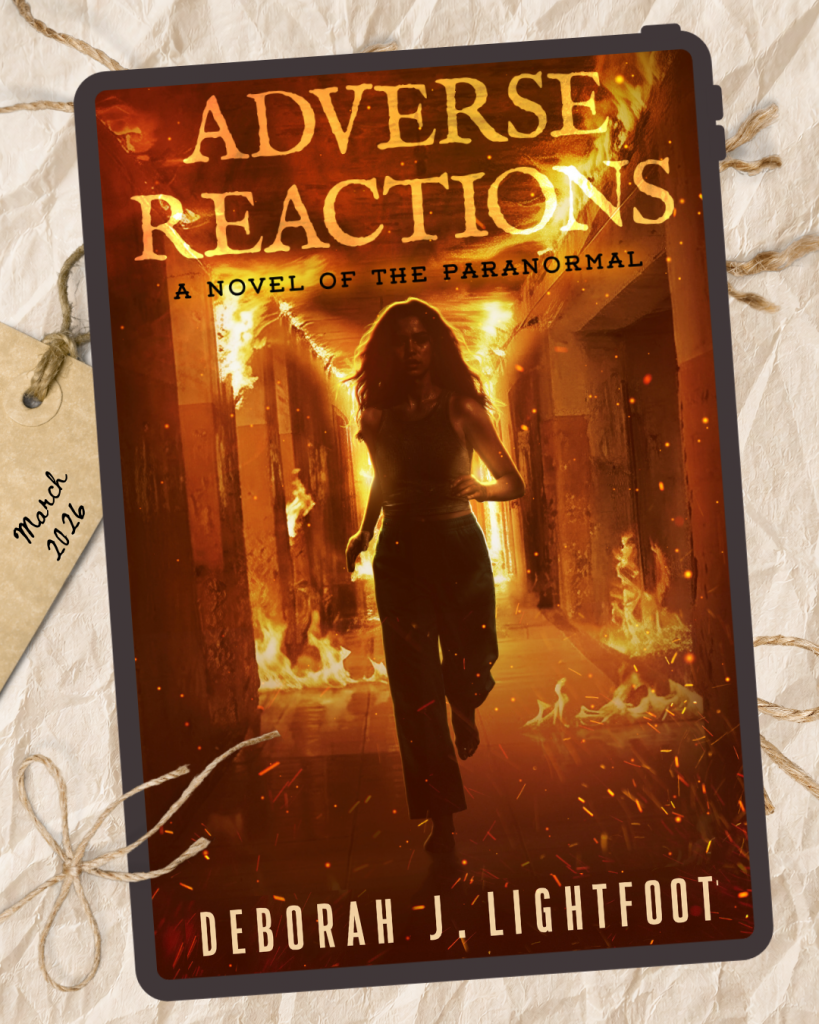
ADVERSE REACTIONS: A Novel of the Paranormal by Deborah J. Lightfoot

That was not the process, however, for Adverse Reactions, my newest book. I have no memory of where the original idea might have come from. It was too long ago: I actually started the book in 2005. I managed 24,000 words of it before I hit a wall. I’d reached the first “plot point”—pivotal moment; major turning point—and I had no clue where things went from there.

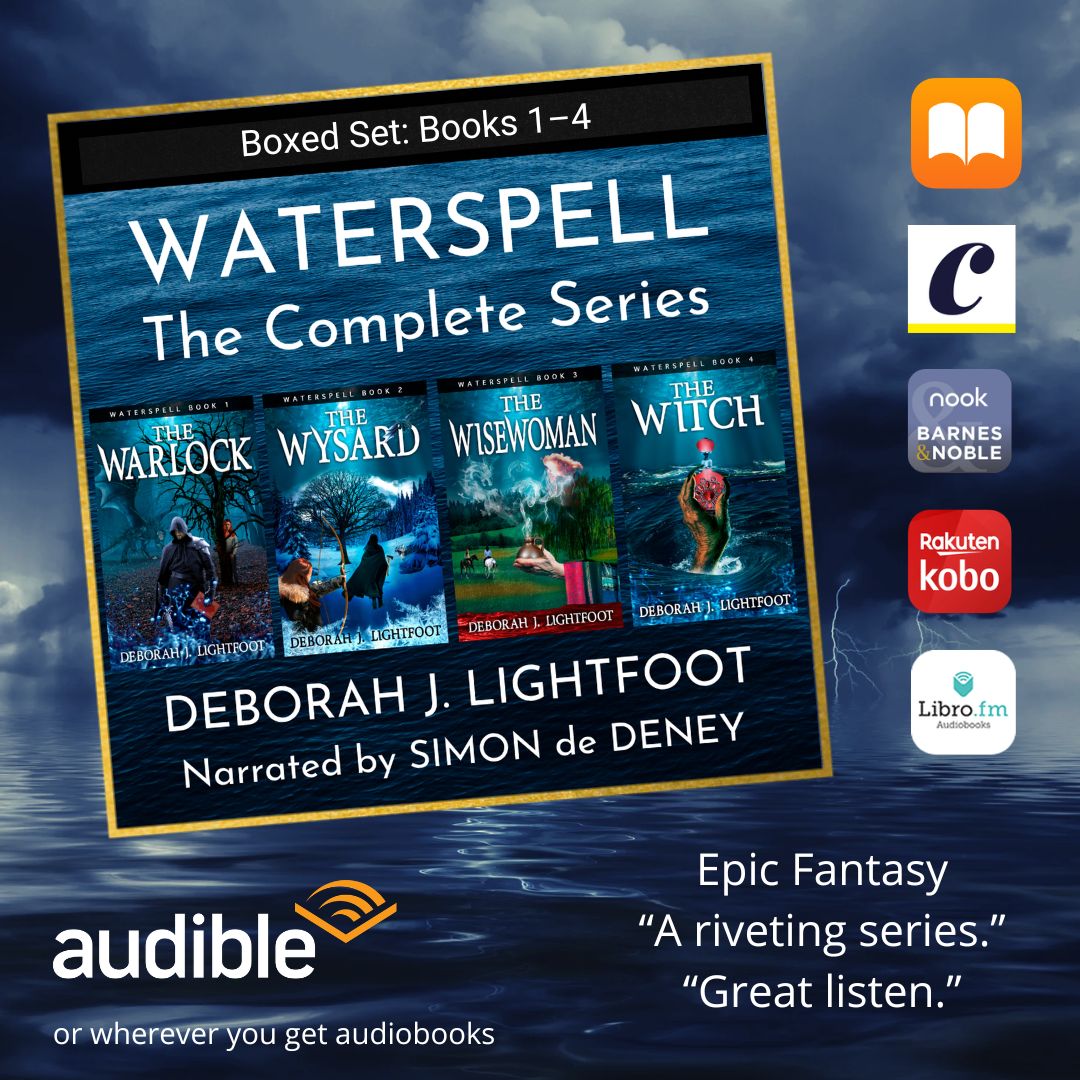
So I shelved the manuscript (plopped it into a file cabinet, actually) and went back to writing the epic fantasy that eventually became Waterspell, a saga that grew by three books in 2022–24 to end up as a six-book series—altogether, more than 680,000 words.

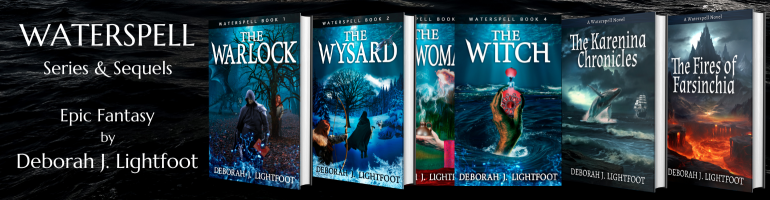
Waterspell epic fantasy by Deborah J. Lightfoot

But I never forgot that partial manuscript. I’m not a person who leaves things undone. I’m determined to finish what I start (even if it takes six books and 680,000 words to do it). In 2025, therefore, I pulled that manuscript out of the file cabinet and sat down to read what I’d written 20 years earlier.

What I found in those rough-draft pages—the compelling urgency of it—surprised even me. The story gripped me. I found myself caring deeply about the protagonist and the awful situation she’s in as the story opens.

What was even better, though, was the way my mind leapt ahead when I reached the end of that 24,000-word partial. A score of years earlier, I hadn’t known where the story went. Now I did. The logical and dramatic next steps in the quest for justice were clear.

During those 20 years, I’d done a lot of writing and a lot of living (some of it hard). I’d gained experience, deepened my understanding of people and their motivations, and observed the good and the evil of which humans are capable. All of that living had equipped me to finish the story—to finish what I’d started, and to do it in a way that has been personally fulfilling.

Thank you for reading, and for spreading the word about my cross-genre, post-apocalyptic, paranormal, gritty modern “Western.”

(This piece first appeared as a guest post at K.M. Jenkins’ Book Nook.)

Leave a Comment

Filed under Adverse Reactions: A Novel of the Paranormal, Books and Readers, On Writing, Waterspell fantasy trilogy, Writers

Snipped Scenes: The Fires of Farsinchia Outtakes

As I work back through my old notes for my novel-in-progress—notes scribbled on scraps of paper, some dating back a year—I find bits that I’m not sure can be incorporated sensibly into the Fires manuscript, but I’m reluctant to trash these bits. Therefore, I’m saving them here, just in case I’m inspired to use them in my final editing passes. “Kill your darlings,” they say. Eliminate any part of your writing—scenes, sentences, descriptions—that you love, but which don’t serve your story. I’m not ready to decapitate the following, so they’ll stay here for now, awaiting their fate.

On the Void’s Time-Warping

On Nina’s Permanent Departure from the Island World

Where Is Nina’s Sword?

Nina’s rapier figured prominently in The Karenina Chronicles (Waterspell Book 5). But in The Fires of Farsinchia (Book 6), it’s nowhere to be seen. That’s because, at the end of KC, Nina had left it at home in Ruain. Thus, she doesn’t have it with her when she makes the leap back through the void to the Ore Hills, at the beginning of Fires.

On Wolfram as Courier

A novel is like an iceberg. Much of the story is out of the reader's sight, known to the author but hidden in the depths.
A novel is like an iceberg. Much of the story is out of the reader’s sight, known to the author but hidden in the depths.

Leave a Comment

Filed under Books and Readers, On Writing, Writers

It’s Good to Talk Shop

Once upon a time I belonged to an in-person writing critique group. The group gave me valuable advice, and I benefited from participation in it. But times changed, and our lives changed, and the group drifted apart, gradually breaking up, or reformulating itself with new members in a different meeting location. I ceased to participate.

These days, I get feedback via email and text messages from my beta readers and reviewers. I also try to engage with other writers on Goodreads and Instagram. Writing is a lonely profession, but it’s not good to work in too much of a vacuum. Even the most introverted among us need to interact with our peers.

A Moment in Time by Martin DukesIt has been my pleasure recently to talk shop with Martin Dukes, author of the Alex Trueman Chronicles. It turns out that Martin and I have followed similar paths with our respective series: we were both away from our work for 10 years.

Coming back to a story after such a long break presents special challenges. I’m sharing our Instagram conversation here, for what it reveals about the issues involved and the concerns we both have as “long-haul authors.”


martin.dukes.wildest.dreams commented: Well done for writing four. How did this work for you? Has there been an obvious evolution in style during the series as you find your way with them? (Just going to Amazon now to get the first one ☺)

booksofwaterspell Thank you! I deeply appreciate your support and your interest. Books 1-3 of Waterspell are really the beginning, middle, and “end” of one continuous story. The new Book 4 is a coda, set five years after the events of the original trilogy. I’m not sure I would recommend that structure: A few readers have been really annoyed by Book 1’s cliffhanger ending. “Golly,” I think when a reader gets angry about it. “I’m giving you Book 1 for free, and several reviews have mentioned that it’s not a standalone, so why the outrage?” I guess I’m so accustomed to fantasy series that go on and on, it never occurred to me that readers would bristle at Book 1 ending on a cliffhanger. As to an evolution in style: I definitely became a more efficient writer. Rereading Books 1-2, I can see that they’re wordy in spots, and draggy in spots. Both would have benefited from a more ruthless paring than I gave them. By Book 3, I was writing more concisely. Partly, I imagine, because the scene had been thoroughly set (and described!) in Bks 1-2. But also because my style did evolve as I continued the saga. Many readers have commented that the series gets better as it goes. Oftentimes it’s the other way around (great first book, disappointing sequels) so I’m happy when readers say that I’ve avoided that trap, at least.

martin.dukes.wildest.dreams I’m surprised that anyone would object to your Book 1 ending on a cliff-hanger, unless it was not already apparent that this was the first in a series. From a writer’s point of view I’m sure such a device is useful in encouraging the reader to move on to Book 2 and a very normal strategy. TBF I could only see one such comment and your other reviews are universally enthusiastic. It’s constantly surprising how some reviewers will settle on one relatively trivial factor and use it as a yardstick by which to condemn the work as a whole! I’m interested to see that you recognise an improvement in your own writing style during the course of the series. I suppose sticking at it and writing them books in quick succession would help with regard to consistency. In my own series there was a gap of about 10 yrs between Books 2 and 3. I have tried very hard to keep things consistent but I’m sure readers will let me know if I haven’t! Did you likewise find that your characters matured and changed over time? (that is, assuming that some of the characters persist from book to book). For my own part, and since a central character is key to the series, I felt that there was a very real maturation as he aged with experience and as I came to know him better over time. Anyway, I wish you all the best with the series, which is evidently highly regarded and well-received.

booksofwaterspell A 10-year gap for you, too, huh. I’m working with the same: My original trilogy 2011-12, now the sequel in 2022. There’s a tension, I think, between achieving consistency but within a framework of growth, for both writer and characters. Like your main character, mine has matured, and her emotionally damaged “significant other” has (mostly) healed. One of my beta readers asked why I didn’t start Book 4 exactly where Book 3 ended (Bk 4 begins five years later). I replied that it wasn’t possible to pick up the story exactly where I’d left it. After my life took a sharp turn during those years, I wasn’t the same person who had written the original trilogy. My characters had also evolved. But I know those people and their story so well, I didn’t have as much trouble writing Book 4 as I thought I might. (Took me eight drafts, but that’s about right.) My beta reader commented: “Rereading the series, I realized your writing really hit its stride with the 3rd book. Not that there was anything wrong with the first two, but the 3rd had an ease about the writing. You’ve maintained that with this book.” I was relieved by her feedback. She confirmed that I’d achieved both some consistency and some growth, which is what a series should have, IMO. Regarding the grousing about Book 1’s cliffhanger: There’s more griping on Goodreads than on Amazon. But I served the story the best I could. If some folks dislike the structure, they have plenty of other books from which to choose!☺I’m looking forward to reading A Moment in Time. It’s up next in my TBR pile.

books of waterspell BTW, I love the cover of A Moment in Time. It’s great.

“It’s constantly surprising how some reviewers will settle on one relatively trivial factor and use it as a yardstick by which to condemn the work as a whole!” —Martin Dukes, author


Leave a Comment

Filed under Books and Readers, Bookstagram, On Writing, Writers

Blurbing Book 4 of Waterspell

Waterspell Book 4 cover detail

Waterspell Book 4 cover detail

A good day’s work. Got my errands done in town this morning, then drafted a heartfelt Author’s Note for the back of Waterspell Book 4 and tweaked the blurb into something I’m almost happy with. Thoughts are welcome. Does this give too much away?

In the House of Verek, it’s five years later. The waters are troubled. Memories are darkening. If the story is to end “happily ever after” for Carin and Verek, old demons must be laid to rest.
Readers of the Waterspell fantasy series will welcome this long-awaited fourth book for the answers it provides to questions raised in volumes 1 through 3: Does the wysard Verek regain his powers, and will Carin make her way back to him? Have Carin’s parents survived the plague that devastated their world, and will she ever see them again? Did Lanse survive the attack by Carin’s defender? Is Lord Legary really dead? And not least: Did the necromancer die in the jaws of Carin’s conjured dragon? Remember: there was no blood in the water. These questions and more are answered in Waterspell Book 4, which picks up the story of the lovers, Carin and Verek, half a decade after readers saw the pair separated in the closing chapters of the original trilogy.

By the blood of Abraxas, it’s about time we learned what happened next.

Leave a Comment

Filed under Books and Readers, Cover Design, Magic, On Writing, Waterspell fantasy trilogy

Character Development: Showing Emotions

Once again, and gratefully, I’m sharing excellent writing advice from author Connie J. Jasperson. It’s very timely. I’m about to settle down, first, as a beta reader for a writer-friend’s work-in-progress, and then to make final (I hope) edits to my own WIP, Waterspell Book 4. Connie’s advice on how to show characters’ emotional states will be fresh in my mind as I undertake to help both my friend and myself Do Our Jobs Better.


Most authors who have been in writing groups for any length of time become adept at writing emotions on a surface level. We bandage our wounded egos and work at showing our characters’ inner demons. We spend hours writing and rewriting, forcing words into facial expressions. Happiness, anger, spite – all the emotions get a […]

Character Development: Showing Emotions — Life in the Realm of Fantasy

1 Comment

Filed under On Writing, Writers

Ruminations on the Third Draft of the Fourth Book (with a blurb-in-progress)

When I sat down to write a fourth book in my Waterspell fantasy series, I wondered whether I still had enough to say about my characters and their world to produce a novel-length work. Turns out, I needn’t have worried. I got Drafts 1 and 2 down on paper in record time: started May 6; had a nearly complete second draft by September 6. After leaving the manuscript sitting for a couple of weeks, I started again at the beginning of the story, checking it against my stacks of notes, looking for loose ends and adding material to address every thread that I wanted to bring forward from the original trilogy. The result is a third draft that’s very nearly complete at just shy of 90,000 words. Book 4 will be the shortest in the series. The previous record-holder for “short” was Book 3, at about 115,000 words.

Book 4’s conciseness stems partly from my not needing to include so much description. The story takes place in settings that readers already know from Books 1 through 3.

I’m aware, however, that I’m relying more on narration in Book 4 than I did in the previous volumes. Between now and the early months of 2021, I plan to let the story sit largely untouched as I hear back from my beta readers and get some distance from the narrative. I’m a bit concerned that this story lacks the immediacy of Books 1 through 3, which were built on you-are-there, “real-time” scene-and-sequel with lots of dialogue and limited narration. Detailed scenes take more words to lay out for the reader than narration requires.

As a writer (and as an individual) I’m in a very different place from who and where I was when I finished the trilogy. It’s no surprise, to me, that my approach to Book 4 differs in tone from the original books. I’m trusting my beta readers (and my gut, once it has gained the necessary distance) to tell me whether my approach to Book 4 will satisfy readers who enjoyed the original story of Carin and Verek, or whether the “new me” is straying too far from readers’ expectations.

In the meantime, here’s the working draft of the book blurb. Any and all comments will be appreciated:

It’s five years later, Carin and Verek are married with children, and the grandparents are calling. Readers of the Waterspell fantasy series will welcome this long-awaited fourth book for the answers it provides to questions raised in volumes 1 through 3: Does the wysard Verek regain his powers, and will Carin make her way back to him? Have Carin’s parents survived the bleeding disease that devastated Earth, and will Carin ever see them again? How is the woodsprite faring in its new world? Has it forgiven the treachery committed by its greatest friend? Will Carin ever forgive herself for abandoning the creature? Does Megella get her wish, to be the wisewoman who midwifes Carin’s children into the world? Will those children bear the mark of their ancestry, or are they fated to be disappointingly ungifted? Did Lanse survive? Is Lord Legary really dead? And not least: Did the necromancer die in the jaws of Carin’s conjured dragon? Remember: There was no blood in the water. These questions and more are answered in Waterspell Book 4: The Witch, which picks up the story of the lovers, Carin and Verek, five years after readers last saw the pair separated in the closing chapters of the series’ third book.
By the blood of Abraxas, it’s about time we learned what happened next.

1 Comment

Filed under Books and Readers, On Writing, Waterspell fantasy trilogy, Writers