Tag Archives: writing advice

Heralds in Fantasy Literature

Heralds, in their original and simplest form, were messengers. In fantasy literature, a herald often brings the message or in some other way triggers the events, sets the events in motion.

In The Hobbit, for example, Gandalf is the herald, or the trigger, that sends Bilbo Baggins off on his grand adventure.

In my Waterspell series, Carin is the herald. Her showing up on the property of the wizard named Verek sets the story action into motion. In effect, she will send Verek off on a quest—and she will participate fully with him on the quest, similar to how Gandalf sets Bilbo into motion and also plays his great role in the events of that story.

But behind Carin in my story, there’s another herald: the character who sets Carin into motion. The events actually begin with that original herald, who is described in Books 1 and 2 as simply “the wisewoman.” Readers won’t know the wisewoman’s whole story until they get to Waterspell Book 3. Immediately at the start of Book 1, however, even before we formally meet Carin in Chapter 1, we see evidence that she’s not acting entirely of her own free will. We learn that the wisewoman has sent her to the wizard Verek.

One thing that complicated the writing of Book 1, Chapter 1, is that I needed to at least hint that Carin isn’t really sure what her goal is, why she’s come north, or what she’s supposed to do when she gets there. She only knows—or she feels, deep in her gut—that she has to be there.

In effect, she’s under a spell—a spell of compulsion. She thinks she’s acting of her own free will, but if she were pressed to explain her motives, she would be hard put to do it. This becomes clearer in Chapter 3, when Verek presses her about her reasons for trespassing on his property. Her explanations don’t satisfy him, and they will—I hope—deepen the sense of mystery that surrounds Carin.

My challenge with Chapter 1 is that many “mainstream” readers expect the main character’s goals and motivations to be clearly laid out right at the start. That’s what they have been taught to expect.

Experienced readers of fantasy, however, will understand that motives and circumstances are often quite murky as the story opens. In Philip Pullman’s The Golden Compass, for instance, the main character, Lyra, has no problem whatsoever as the story opens. She’s having fun. She’s exploring a forbidden part of the college where she lives, and she’s enjoying herself. The big problem that she will face does not become clear for a very long time, as the trilogy unfolds.

So what I’ve tried to accomplish with Chapter 1 of my fantasy series is to present Carin as a strong, active, decisive character, but I have also had to hint that she’s been set on this course, this particular path, by forces beyond her control and by circumstances she did not create. She’s being used, quite frankly, but she’s not a pawn.

In a sense, she’s like King Arthur’s sword, Excalibur. He used the sword—only Arthur as the rightful king could wield it—but Excalibur had magical powers of its own. It allowed itself to be used only by the rightful king.

My girl, Carin, very definitely has a say in how she’s being “used” by the original herald, the wisewoman in the south, and then by the wizard Verek once she follows the wisewoman’s instructions and finds him, up north.

The Book 1 Prologue helps to clarify what’s driving Carin, what her goal is, what problem she must overcome. Here’s an excerpt:

Prologue

The Path Ahead

The wisewoman never asked directly, never demanded of Carin: “Where do you come from, you strange, surprising child? Who are you?” But she breathed her questions in an undertone when she thought Carin couldn’t hear.

Time passed, and the woman watched with shrewd regard, ever wondering. What’s going on, girl, behind those cool green eyes that view the world with such detachment? You’ve borne up patiently these five years, with your gaze cast groundward to hide your thoughts from those who think you have none. Oh, you’re a self-contained little wight, as guarded in your speech as in your glances. You pretend to be indifferent to your past and resigned to your present. But I have seen you puzzling beside the millpond, gazing into its waters, wondering: ‘What brought me here? Where did this journey start, and where do I go now?’

The seasons turned, and at last the wisewoman drew Carin aside. “I have considered carefully. Indeed, child, I have thought of little else. Still I cannot fathom where your journey began. But I clearly see the path that lies before you now.”

The woman did not point. She would not risk drawing anyone’s eye to the pair standing apart. She merely tipped her head, keeping her hand hidden in the folds of her shawls, tightly gripping the amulet she had fashioned against this moment.

“Go north, girl,” she ordered, her gaze locked with Carin’s. “Run from here. You have no home in this village. Granger is much too hidebound and suspicious for the likes of you. Your place is in the North. If you belong anywhere, child, you belong there.”

Leave a Comment

Filed under Books and Readers, Magic, Waterspell fantasy trilogy, Writers

“Where Do You Get Your Ideas?”

Every writer gets asked: Where do the ideas come from?

For many of us, the question is so unanswerable, we can only smile gently and deflect. Have you heard about the warehouse in Poughkeepsie where ideas can be had wholesale, a dime a dozen? (Wink, wink)

Seriously, most writers have no real idea where the ideas come from. Ideas well up from the subconscious, far below the level of awareness. More than once, as I’ve come awake in the morning, I’ve had the entire plot of a book running through my head. It’s a mad dash to the keyboard then, stopping only to grab a cup of coffee before feverishly pounding out the main points of the plot before the whole thing evaporates back into the ether from which it came.

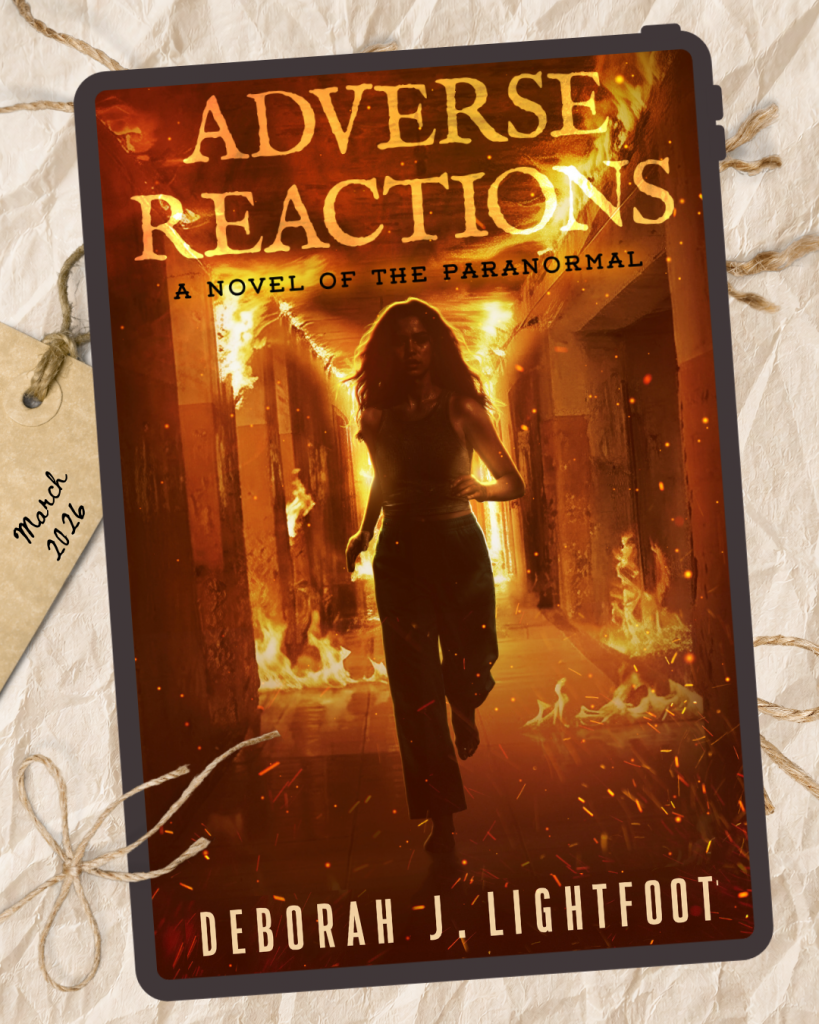
ADVERSE REACTIONS: A Novel of the Paranormal by Deborah J. Lightfoot

That was not the process, however, for Adverse Reactions, my newest book. I have no memory of where the original idea might have come from. It was too long ago: I actually started the book in 2005. I managed 24,000 words of it before I hit a wall. I’d reached the first “plot point”—pivotal moment; major turning point—and I had no clue where things went from there.

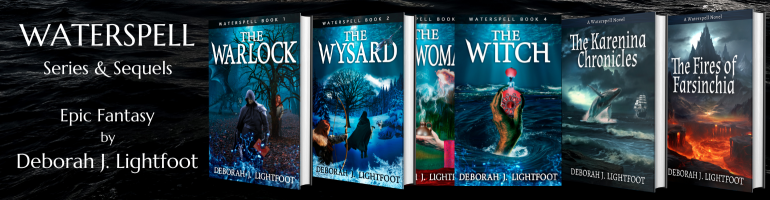
So I shelved the manuscript (plopped it into a file cabinet, actually) and went back to writing the epic fantasy that eventually became Waterspell, a saga that grew by three books in 2022–24 to end up as a six-book series—altogether, more than 680,000 words.

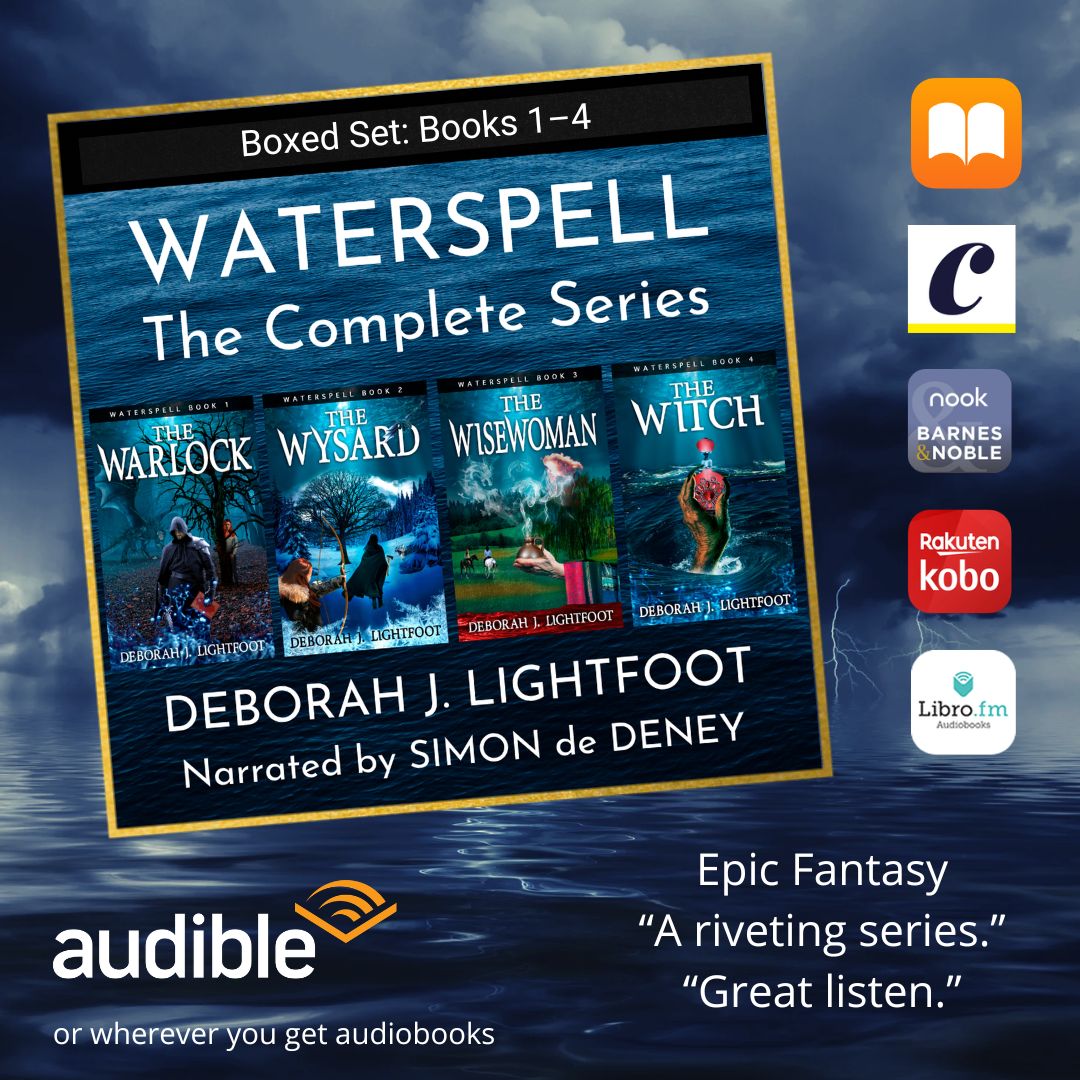
Waterspell epic fantasy by Deborah J. Lightfoot

But I never forgot that partial manuscript. I’m not a person who leaves things undone. I’m determined to finish what I start (even if it takes six books and 680,000 words to do it). In 2025, therefore, I pulled that manuscript out of the file cabinet and sat down to read what I’d written 20 years earlier.

What I found in those rough-draft pages—the compelling urgency of it—surprised even me. The story gripped me. I found myself caring deeply about the protagonist and the awful situation she’s in as the story opens.

What was even better, though, was the way my mind leapt ahead when I reached the end of that 24,000-word partial. A score of years earlier, I hadn’t known where the story went. Now I did. The logical and dramatic next steps in the quest for justice were clear.

During those 20 years, I’d done a lot of writing and a lot of living (some of it hard). I’d gained experience, deepened my understanding of people and their motivations, and observed the good and the evil of which humans are capable. All of that living had equipped me to finish the story—to finish what I’d started, and to do it in a way that has been personally fulfilling.

Thank you for reading, and for spreading the word about my cross-genre, post-apocalyptic, paranormal, gritty modern “Western.”

(This piece first appeared as a guest post at K.M. Jenkins’ Book Nook.)

Leave a Comment

Filed under Adverse Reactions: A Novel of the Paranormal, Books and Readers, On Writing, Waterspell fantasy trilogy, Writers

New In Books: Interview with Deborah J. Lightfoot, Author of Adverse Reactions

by NewInBooks
in Author InterviewsFantasy & Science FictionNews
15 April 2026

What’s the story behind the story? What inspired you to write this book?

ADVERSE REACTIONS: A Novel of the Paranormal by Deborah J. Lightfoot

I don’t remember and can’t even guess where the original idea came from. I actually started the book in 2005, but managed only 24,000 words before hitting a wall. I got stuck at the first plot point. So I shoved the manuscript into a file cabinet and returned to writing the epic fantasy that eventually became my six-book Waterspell series. But I never forgot that partial manuscript. Last summer, I unearthed it and read what I’d written 20 years before. What I found in those rough-draft pages—the compelling urgency of it—surprised me.

The awful situation the protagonist is in, as the story opens, grabbed and held me. And more than that: my mind leapt ahead when I reached the first plot point. A score of years earlier, I hadn’t known where the story went from there. But now I did. The logical and dramatic next steps in the quest for justice were clear. During the book’s 20-year incubation, I’d done a lot of writing and a lot of living. I’d gained experience, deepened my understanding of people and their motivations, and observed the good and the evil of which humans are capable. All of that equipped me to finish the story, and to do it in a way that has been personally fulfilling.

Pick theme songs for the main characters of your book.
Adverse Reactions is a post-apocalyptic, paranormal, suspense-thriller, Western fantasy. It crosses genres! The Great Plains setting evokes the theme song from the movie, Once Upon a Time in the West. Another classic film score that would fit is The Good, the Bad and the Ugly.

What’s your favorite genre to read? Is it the same as your favorite genre to write?
I mainly read and write fantasy, with a fair amount of science fiction on the side. As a kid, the first book I bought with my own money was Daybreak—2250 A.D., post-apocalyptic science fiction by the great Andre Norton. I fell in love with Norton’s books and her writing style. Currently, I’m catching up on her Witch World fantasy novels that I somehow missed in my adolescence.

What books are on your TBR pile right now?
So many! Too many! Besides the Witch World books, which are numerous, I’m into the Sally Lockhart mysteries by Philip Pullman, published between 1985 and 1994. The final book of that series came out just a year before The Golden Compass. I recently listened to the audiobooks of The Book of Dust sequels, and as a fantasy writer I was interested in Pullman’s transition from mystery to fantasy. I’m enjoying the Sally Lockhart books, but honestly, I wouldn’t have thought they were written by the same man who would go on to write the incomparable His Dark Materials. Pullman made an inspired leap with Lyra Belacqua’s story, his masterpiece.

What scene in your book was your favorite to write?
I’d have to say it’s when my protagonist, Devin, meets Mike Sutter, a complicated man who is the definition of “morally gray.” Sometimes he’s kind and generous. Other times, he’s ruthless to the point of cruelty. He’s got his own agenda, as Devin soon discovers.

Do you have any quirky writing habits?
I sit down at the computer, and in strict and unvarying order, I arrange these:

  • Web browser, taskbar bottom-left, ready to look up synonyms and make sure a word really means what I think it means
  • Word processing program center-screen—plain old Word, nothing fancy
  • Dictionary, taskbar bottom-right, my trusty Merriam-Webster
  • On the writing desk nearby, a hardback copy of the Oxford Thesaurus (American Edition)

I cannot proceed without those things at my fingertips, and in that order. I also require a cup of coffee, a mug of water, and the hum of the air conditioner. Those will keep me pounding the keyboard for hours, until the coffee and water dictate a break. 😊

Do you have a motto, quote or philosophy you live by?

“The soul that has no fixed goal loses itself; for as they say, to be everywhere is to be nowhere.” —Michel de Montaigne

Leave a Comment

Filed under Adverse Reactions: A Novel of the Paranormal, Books and Readers, Discoverability, On Writing, Waterspell fantasy trilogy, Writers

What Makes Great Dialogue?

Dialogue should sound natural—like real people talking. Or more precisely, like really interesting real people talking.

Strive to write dialogue as the natural outcome of the characters’ needs, desires, thoughts, personalities, reactions, and relationships. Don’t use it to dump information on the reader or, even worse, use it just to break up long passages of narrative.

Avoid commonplace dialogue—characters taking up space saying empty things like “Hi, how are you?” and “Fine, how are you?”

Literary agent Noah Lukeman wrote in his classic book, The First Five Pages:

“The presence of commonplace dialogue means the manuscript as a whole will need a lot of cutting: if there is one extraneous line of dialogue on the first page, by the rule of manuscripts, you will also find one extraneous line on each page to come.”

According to Lukeman:

“Dialogue is a powerful tool, to be used sparingly, effectively and at the right moment.”

I greatly admire Ursula Le Guin. (If you don’t know her work, read the Earthsea books—you’ll be swept away.) For examples of pitch-perfect dialogue, see her Tales From Earthsea. Below is an excerpt. Study it and see all that it does, the many levels on which this dialogue succeeds.

We learn the personalities of father and son. The son is quiet, he doesn’t say much. He’s subject to his father’s will, but he’s hoping his old man will stop pressuring him. The father is obviously conflicted: proud of his son’s gift, but disappointed that it doesn’t make the boy suitable to follow in his dad’s footsteps in the family business. The father is also in awe of his child’s talents. We learn so much from this dialogue, and the whole exchange rings true. Believable personalities are revealed.

Also study this passage for examples of how to punctuate dialogue, and how to break up the speaking with a little action. People move around, gesture, pause. They don’t just stand and talk.

The next morning Golden told his son again that he must think about being a man.

“I have thought some about it,” said the boy, in his husky voice.

“And?”

“Well, I,” said Diamond, and stuck.

“I’d always counted on your going into the family business,” Golden said. His tone was neutral, and Diamond said nothing. “Have you had any ideas of what you want to do?”

“Sometimes.”

“Did you talk at all to Master Hemlock?”

Diamond hesitated and said, “No.” He looked a question at his father.

“I talked to him last night,” Golden said. “He said to me that there are certain natural gifts which it’s not only difficult but actually wrong, harmful, to suppress.”

The light had come back into Diamond’s dark eyes.

“The master said that such gifts or capacities, untrained, are not only wasted, but may be dangerous. The art must be learned, and practiced, he said.”

Diamond’s face shone.

“But, he said, it must be learned and practiced for its own sake.”

Diamond nodded eagerly.

“If it’s a real gift, an unusual capacity, that’s even more true. A witch with her love potions can’t do much harm, but even a village sorcerer, he said, must take care, for if the art is used for base ends, it becomes weak and noxious … Of course, even a sorcerer gets paid. And wizards, as you know, live with lords, and have what they wish.”

Diamond was listening intently, frowning a little.

“So, to be blunt about it, if you have this gift, Diamond, it’s of no use, directly, to our business. It has to be cultivated on its own terms, and kept under control — learned and mastered. Only then, he said, can your teachers begin to tell you what to do with it, what good it will do you. Or others,” he added conscientiously.

There was a long pause.

“I told him,” Golden said, “that I had seen you, with a turn of your hand and a single word, change a wooden carving of a bird into a bird that flew up and sang. I’ve seen you make a light glow in thin air. You didn’t know I was watching. I’ve watched and said nothing for a long time. I didn’t want to make too much of mere childish play. But I believe you have a gift, perhaps a great gift. When I told Master Hemlock what I’d seen you do, he agreed with me. He said that you may go study with him in South Port for a year, or perhaps longer.”

“Study with Master Hemlock?” said Diamond, his voice up half an octave.

“If you wish.”

“I, I, I never thought about it. Can I think about it? For a while — a day?”

“Of course,” Golden said, pleased with his son’s caution. He had thought Diamond might leap at the offer, which would have been natural, perhaps, but painful to the father, the owl who had — perhaps — hatched out an eagle.

(From “Darkrose and Diamond,” Tales From Earthsea, copyright 2001 by Ursula K. LeGuin)

Leave a Comment

Filed under Magic, On Writing, Writers

How to Handle Mean Reviews

They’re inevitable. Every writer gets them. Even rich and famous authors get bad reviews.

Some of the best advice I’ve ever read, on how to handle the trolls, comes from Julia Whelan at Writer Unboxed. I excerpted some of her comments to give ’em the Canva treatment. But every writer will do well to read her entire post.

Julia Whelan quote 1

Julia Whelan is a screenwriter, lifelong actor, and award-winning audiobook narrator of more than 500 titles. Her performance of her own debut novel, the internationally best-selling My Oxford Year, garnered a Society of Voice Arts award. She is also a Grammy-nominated audiobook director, a former writing tutor, a half-decent amateur baker, and a certified tea sommelier. Her new book, Thank You for Listening—about a former actress turned successful audiobook narrator who has lost sight of her dreams and her journey of self-discovery, love, and acceptance when she agrees to narrate one last romance novel—released in August 2022.

Julia Whelan quote 2

Leave a Comment

Filed under Audiobooks, Books and Readers, On Writing, Writers

Write Every Day: Bad Advice?

“Write every day” is standard advice to writers. We’ve all heard it. I used to feel guilty because I do NOT write every day. I regarded my failure to do so as … well, a failure.

Now I know better. After eight books with a ninth in progress, I know what pattern or schedule works for me. I’m a binge writer, an all-or-nothing kind of wordsmith. When I’m writing, I don’t want to do anything else except drink coffee, eat when I start getting the shakes, and sleep when I must. That kind of intensity is productive, but exhausting. I can only keep it up for three days. Then, I must have a break.

Today was my non-writing day of “rest.” I’ve spent it doing a bunch of things that writers must do:

  • Checked Goodreads for new reviews (and found a lovely one)
  • Checked on my audiobook sales via Findaway Voices (and found a good number of new sales)
  • Found a new link for my audiobook at Hoopla
  • Found a new link for all four books of the Waterspell series at Overdrive / Libby
  • Updated my Books2Read universal book links (UBLs) with those new links
  • Scheduled a December 16 book promo with The Fussy Librarian
  • Communicated with my local library about adding Waterspell to their catalog
  • Made a new Bookstagram graphic with the lovely Goodreads review
  • Wrote this blog post

Waterspell review at Goodreads October 2022Additionally, I fulfilled my obligations to a save-American-democracy group in which I’m active in the area of Communications. And: I watched the Jan. 6 Committee Hearing on PBS. Busy day!

Would I have wanted to break away from my work-in-progress to do any of these things? Absolutely not. I suppose there are writers who can write fiction for just 4 hours in a day, and then put the book out of their mind, to focus on such mundane tasks as I’ve listed above. I’m not one of those writers. A far more productive approach, for me, is to devote whole days at a stretch to my writing, and to nothing else.

At the end of three intense days, I’m totally ready to turn my mind to less taxing tasks. By the same token, after one or two days of necessary but boring administrative/business work, I’m eager to throw myself back into the world of my imagination.

“Write every day” is a recipe for burnout, in my opinion. If you’re really into the story and the people you’re writing about, your mind and psyche can’t keep you deeply “in character,” indefinitely. You need a break. You need to come up for air, and spend a little time away from the story so you can return to it, refreshed. And unless you’re able to afford a personal assistant who can handle all of your non-writing jobs, you need to set aside time to tackle your To-Do list.

Don’t cut into your writing time to do those boring jobs. Hold your writing days sacrosanct. Set your phone to Do Not Disturb and commit yourself to do nothing except Write.

But don’t “write every day.” You’ve got other things to do.

Leave a Comment

Filed under On Writing, Writers

Character Development: Showing Emotions

Once again, and gratefully, I’m sharing excellent writing advice from author Connie J. Jasperson. It’s very timely. I’m about to settle down, first, as a beta reader for a writer-friend’s work-in-progress, and then to make final (I hope) edits to my own WIP, Waterspell Book 4. Connie’s advice on how to show characters’ emotional states will be fresh in my mind as I undertake to help both my friend and myself Do Our Jobs Better.


Most authors who have been in writing groups for any length of time become adept at writing emotions on a surface level. We bandage our wounded egos and work at showing our characters’ inner demons. We spend hours writing and rewriting, forcing words into facial expressions. Happiness, anger, spite – all the emotions get a […]

Character Development: Showing Emotions — Life in the Realm of Fantasy

1 Comment

Filed under On Writing, Writers

Character Development: Motivation drives the story

Here’s excellent writing advice from author Connie J. Jasperson. I’m pleased to reblog her post, as follows, and I invite you to follow Connie at conniejjasperson.com.

You have probably heard of the literary rule known as Chekhov’s Gun, which says nothing should appear in the scene that has no use. If a rifle is important enough to be shown hanging on the wall, someone had better fire it, or it should be removed from the setting. Firing Chekhov’s gun brings us […]

Character Development: Motivation drives the story #amwriting — Life in the Realm of Fantasy

3 Comments

Filed under Books and Readers, On Writing, Writers

Where Do Ideas Come From?

My habit of letting the draft of a novel sit for at least two weeks has paid off: On my walk this morning, I suddenly got an interesting idea for introducing a plot twist that will bring readers face-to-face with characters who have previously appeared only in the background. Adding this element to Draft 3 will require additional writing but minimal rewriting. The idea arrived, seemingly out of nowhere, on the 14th day of me setting the ms. aside to marinate in its own juices. The subconscious is a powerful asset when it’s allowed to work its magic in its own time and way.

Leave a Comment

Filed under Books and Readers, On Writing, Writers

I Swear

I’m an information junkie. I’m always collecting it — tearing articles out of magazines (yes, I still subscribe to ink-on-paper magazines); quoting the best bits I read and hear; even passing along catalogs like the one from The Teaching Company for The Great Courses.

Image

(Illustration by Corliss Elizabeth Williams for Time)


Possibly I’m a low-level hoarder. I’ve kept an article I tore out of the August 10, 2009, TIME magazine: “Why Swearing Is Good for You.” Author Tiffany Sharples says that swearing “can do more than vent frustration: it can actually reduce physical pain.” A study in Britain found that test subjects could endure painfully cold water longer while swearing. Repeating “a curse word of their choice” made the ice water feel less intensely painful.

“In swearing,” said the study’s lead author, “people have an emotional response, and it’s the emotional response that actually triggers the reduction of pain.”

I passed along a copy of that article to a writer friend who often advises his colleagues to “put more cussing” in our stories. He seems to instinctively appreciate the emotional power of swearing.

Of course, for those of us who write young-adult fiction, swearwords can be problematical. Some teachers, librarians, and parents frown on including obscenities in stories aimed at teenage (and up) readers.

In my YA / new-adult fantasy trilogy Waterspell, my deuteragonist (the character taking the part of second importance) swears like a sailor, and my protagonist, Carin, can almost match him. Their swearing habits are essential to revealing who these characters are.

To get around the objections that would surely be raised if I had used standard American profanity, I gave my characters a different divinity to swear by. They’re in a parallel universe, so it makes sense that their holy figures would have different names than the gods do on Earth. Instead of swearing “By God!” it’s “By Drisha!” in their world.

Another helpful source of inoffensive profanity comes from old English expressions like “gorblimey,” which is a euphemism for “God blind me.” My wizard is fond of saying “Drisha blind me!” It makes people wince in his world, since it’s such a strong oath to them. But Earthlings are not offended.

In my never-ending quest for good, pain-relieving swearing, I mine sources such as old Irish fairy and folk tales. From them I’ve gotten such gems as “A thousand murders!” and “My breath and blood!”

Thanks to TIME’s Tiffany for giving me even more reasons to collect the best in profanity. My characters get into painful situations that require them to vent via a good outburst of colorful language.

Leave a Comment

Filed under Uncategorized