Tag Archives: fantasy

People Don’t Change? Yes, They Do.

This quote has meant the world to me at different times in my life, and in different ways.

After my husband died, suddenly and unexpectedly, leaving me nonfunctional for a trackless time, Cheryl Strayed’s words helped me on my journey toward understanding that his death had changed not only the circumstances of my life … his death had changed me. For a long time afterward, I was incapable of feeling any deep emotion except anger. Grief had wrung me out and left me emptied. Grief had taken my motivation, ambition, concentration … my caring. There were years when I truly didn’t care whether I lived or died. I’d lost my identity. All my old ideas about myself weren’t true anymore.

During those years, I felt no desire or impulse to write, or even to acknowledge that I had written. Cheryl’s words gave me permission to give up the idea that I was a writer. It wasn’t true anymore, it was an old, defunct notion of myself, and if I tried to cling to an identity that I had worn in my death-haunted past, it would mean surrendering the tiny sparks of joy that were slowly beginning to appear in my present.

After the unthinkable happened in November 2016 and America began marching toward fascism, my patriotism awoke and I got deeply involved in political activism. I made protest signs, I took to the streets, I registered voters, mailed postcards to voters, knocked on doors for progressive candidates, held office in a local group of liberal women … put in long hours doing everything I could to save my country from a dangerous sociopath. Few of my fellow and sister activists even knew that I had had a professional career in publishing, had edited magazines and books, and had written seven books including a fantasy trilogy.

Then came the year 2020, and coronavirus.

The virus was in America in January, but as I look back at my January 2020 calendar I see only my activism: political meetings, blockwalking for candidates, registering voters, attending the nearest Women’s March. Then February, and more of the same: protesting the treatment of asylum seekers at the Texas-Mexico border; attending candidate forums; getting trained on new computers for Election Day; working Early Voting. In amongst the activism I had the flu (or was it coronavirus? an antibody test may eventually tell me). While working Early Voting I caught a terrible head-cold that still plagued me when I put in a 15-hour day on March 3 as an election judge for the Democratic Primary.

My final political meeting happened on March 10. By then, cases of Covid-19 were being reported in the urban county next door, and all my activist friends decided it was time we hunkered down. I went to the supermarket on March 13—my final time to actually go inside the store. Since then, it’s been all pickup orders, with me staying safely in my vehicle while heroic grocery workers bring food to me.

Physical isolation = Time

I suddenly found myself with time again. After years of being exhaustively involved in political work, I was suddenly cocooned at home with my computer, my Internet connection, and a Nook tablet full of audiobooks. Thanks to my sister-in-law, who gave me an Audible membership for Christmas 2019, I had recently finished listening to The Lord of the Rings narrated by Rob Inglis. A masterful performance.

And an inspiration. Though I wasn’t writing now, I had written. I had a fantasy trilogy to my credit, which many readers had described as cinematographic. While I was writing Waterspell, I saw the story play in my head as a movie, and evidently that’s how it plays for my readers. I found the LOTR audiobooks to be even better than the films—they were as cinematographic as the movies, but unabridged, complete in every detail, the perfect synthesis—book-plus-movie equal audiobook.

Inspiration begat action. Production on the Waterspell audiobooks began on March 18. My narrator is breathtakingly good. He gives me goosebumps with his interpretation of my story.

And once again, Cheryl Strayed is helping me give up an old idea so I can embrace the joy—the change—that comes with a new idea. I spent years trying to save America from itself. But honestly, if coronavirus isn’t enough to remove a pathological narcissist from office—and all his soulless enablers with him—then there’s little I can do with my protest signs, political meetings, and earnest postcards.

I am not willing to surrender my newfound joy for my old idea that I’m somehow essential to saving the country. If it were ever true, it isn’t true now. I’ve acknowledged anew that I have written. Whether that will translate into new writing (Waterspell Book 4?) remains to be seen. But once again, I am changed. I can feel again. I can care again. I am experiencing emotions that are higher and better and deeper than anger. Motivation is returning, and even a hint of ambition.

Thank you, sister Suzy, for the gift of audiobooks, which planted the seed of the joyous new idea. Thank you, Cheryl Strayed, for giving me permission (thrice) to let go of the old and receive the gift of the new … The gift of the future.

Cheryl-Strayed-Quote-Don-t-surrender-all-your-joy


Leave a Comment

Filed under Books and Readers, On Writing, Waterspell fantasy trilogy

Traditions of Celtic Mythology: How Waterspell Fits

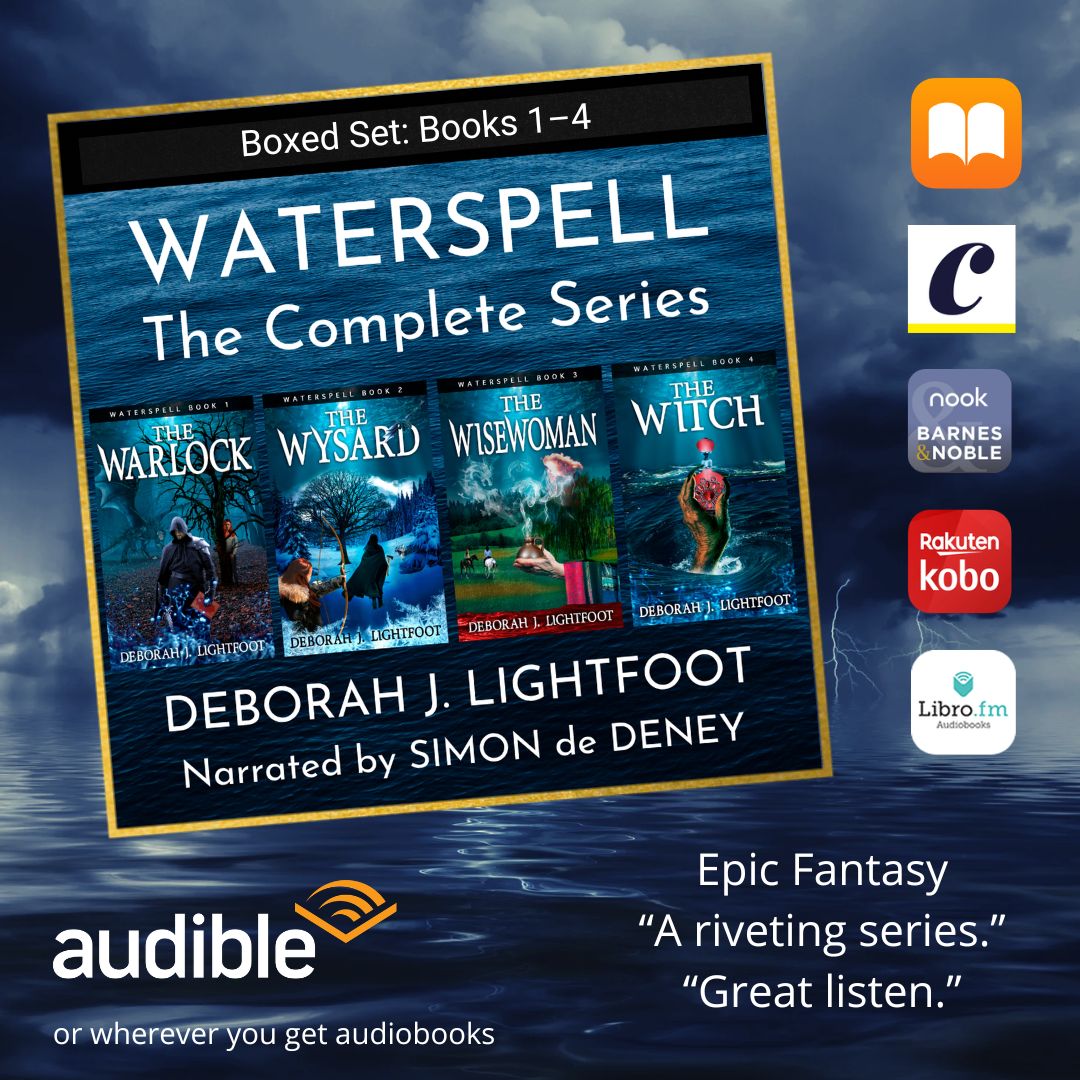
Waterspell fantasy series by Deborah J. Lightfoot. Review: "The world-building was amazing but the characters pulled me in."

A reader and reviewer (she’s also an editor of long experience and impeccable taste) paid me an enormous compliment when she advised her Facebook friends to read my books because “Waterspell is solidly in the class of great epic fantasy (e.g., Tolkien, George R. R. Martin); definitely not namby, trite fantasy, of which there is far too much.”

Humbled to the earth by such praise, I was moved to recall an earlier discussion with an interviewer during the long years I spent researching and writing the Waterspell books. Below are excerpts (the full interview is here).

Q: Does WATERSPELL take its inspiration from Celtic mythology?

A: Broadly and indirectly, yes. When I started reading the early Irish legends and Celtic myths, I was looking mainly for “the telling detail”—authentic figures of speech, colorful descriptive terms, gritty background textures. But as I read, I noticed that aspects of the mythology had their counterparts in this fantasy I was writing. Or vice versa. For instance, water often has mystical qualities in the legends—Irish rivers like the Boyne were held sacred. It’s pretty obvious from the series title—Waterspell—that water has magical properties in my story, too. The traditions tell of quests, leading into the Otherworld and back. “Other worlds” figure prominently in Waterspell: the premise being that what’s harmless in one world or reality may prove deadly if it arrives, whether innocently or by skullduggery, where it doesn’t belong. Also central to my work is the heroic quest, undertaken to gain information or wisdom, to bring healing, or to find or restore lost objects.

I am by no means an expert on Irish legends. Given the huge number of books that have been produced on the subject and the very few of them that I’ve read, I can barely claim a nodding acquaintance. My sole aim, in working into my writings details from the legends, is to make Waterspell “fit” into the world of Celtic mythology the way Tolkien’s Lord of the Rings fits with traditional Scandinavian mythology.

Obviously I’m thrilled to have a reader/reviewer make the connection independently. That tells me I succeeded, at least on some level, in my attempt to pay homage to those great old Irish and Scottish storytellers who are a link to the Celtic mythology that underpins much of the fantasy genre.

Thank you, Shelley! ♥

Leave a Comment

Filed under Books and Readers, Magic, Waterspell fantasy trilogy

I Swear

Illustration by Corliss Elizabeth Williams for Time Magazine

I’m an information junkie. I’m always collecting it — tearing articles out of magazines (I still subscribe to ink-on-paper magazines); quoting the best bits; passing along items that interest me. Possibly I’m a low-level hoarder.

(Illustration by Corliss Elizabeth Williams for Time)

I’ve kept an article I tore out of the July 15, 2009, TIME magazine: “Why Swearing Is Good for You.” Author Tiffany Sharples says that swearing “can do more than vent frustration: it can actually reduce physical pain.” A study in Britain found that test subjects could endure painfully cold water longer while swearing. Repeating “a curse word of their choice” made the ice water feel less intensely painful.

“In swearing,” said the study’s lead author, “people have an emotional response, and it’s the emotional response that actually triggers the reduction of pain.”

I passed along a copy of that article to a writer friend who often advised his colleagues to “put more cussing” in our stories. He seemed to instinctively appreciate the emotional power of swearing.

Of course, for those who write young-adult fiction, swearwords can be problematical. Some teachers, librarians, and parents frown on including obscenities in stories aimed at teenage (and up) readers.

In my high-YA / crossover fantasy series Waterspell, my deuteragonist (the character taking the part of second importance) swears like a sailor, and my protagonist, Carin, can almost match him. Their swearing habits are essential to revealing who these characters are.

To get around the objections that would be raised if I used standard American profanity, I gave my characters a different divinity to swear by. They are in a parallel universe, so it makes sense that their holy figures would have different names than the gods do on Earth. Instead of swearing “by God!” it’s “by Drisha!” in their world.

Another helpful source of inoffensive profanity comes from old English expressions like “gorblimey,” which is a euphemism for “God blind me.” My wizard is fond of saying “Drisha blind me!” It makes people wince in his world, since it’s such a strong oath to them. But Earthlings are not offended.

In my never-ending quest for good, pain-relieving swearing, I mine sources such as old Irish fairy and folk tales. From them I’ve gotten such gems as “A thousand murders!” and “My breath and blood!”

Thanks to TIME’s Tiffany Sharples for giving me even more reasons to collect the best in profanity. My characters get into painful situations that require them to vent via a good outburst of colorful language.

Leave a Comment

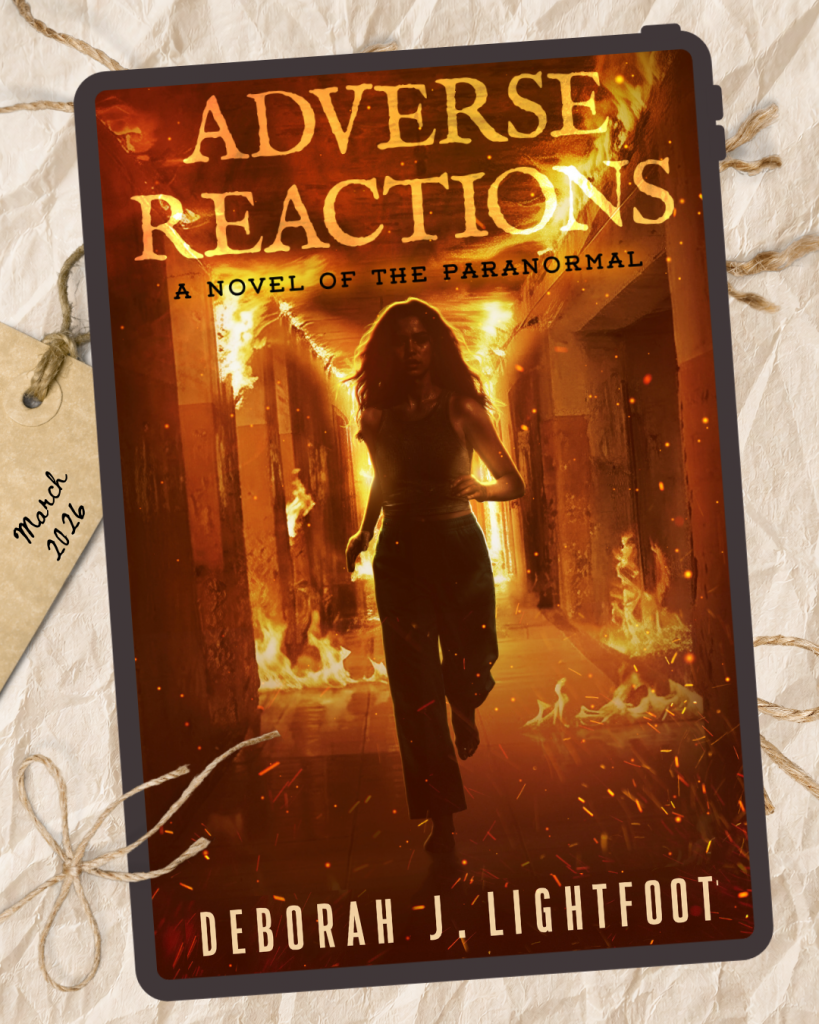
Filed under Adverse Reactions: A Novel of the Paranormal, Books and Readers, On Writing

Alice’s Adventures in Wonderland: Alice150 Exhibit at Harry Ransom Center, Austin, Texas

On Saturday, April 18, 2015, I had the great pleasure of seeing the “Alice’s Adventures in Wonderland” exhibit at the Harry Ransom Center in Austin, Texas, as part of the spring meeting of the Lewis Carroll Society of North America. The exhibition was wonderfully done, tracing this classic tale from its inspiration, little Alice Liddell, on through 150 years of translation, interpretation, adaptation, and illustration.

Alice150LogoHere are a few photos from my visit.

Ransom banners

At the Harry Ransom Center, Austin, Texas, through July 6, 2015

Deborah J Lightfoot with Alice

I’m helping Alice fend off the cards!

Alice popup_best

I love pop-up books, so I was drooling over an entire display case full of them.

Alice translations

Alice in Wonderland has been translated into a staggering number of languages.

Ransom brochure

The exhibition guide/brochure is a keeper. When I’m done showing it around, I’ll be slipping it inside my copy of Martin Gardner’s “The Annotated Alice” to save it for posterity.

While rabbit

“Oh my ears and whiskers. I’m late! I’m late!” 

1 Comment

Filed under Alice in Wonderland, Waterspell fantasy trilogy

Alice in Wonderland 150th Anniversary

Pool of Tears

In 2015 we celebrate the 150th anniversary of the Alice in Wonderland books. Many celebrations are planned worldwide, and I will be participating in my own way too, because of Waterspell‘s Through the Looking-Glass connection and simply because I’m a lifelong Alice fan.

Closest to home for me, the Lewis Carroll Society of North America (LCSNA) will hold its spring meeting at the Harry Ransom Center in Austin, Texas. The Ransom Center is hosting an Alice’s Adventures in Wonderland exhibition based on the center’s extensive collections of art, photography, rare books, performing arts, films, and manuscripts. LCSNA will meet there on April 18, 2015.

All this year, I’ll be blogging occasionally (my blogging is haphazard at best) to bring you updates and information about events of interest. Now is a great time to dust off your old copy of the Alice books and return to Wonderland. And while you’re at it, dive into the Alice-connected and critically acclaimed world of Waterspell.

Happy reading!


2 Comments

Filed under Alice in Wonderland, Waterspell fantasy trilogy