Category Archives: Uncategorized

Traditions of Celtic Mythology: How Waterspell Fits

A reader and reviewer (she’s also an editor of long experience and impeccable taste) recently paid me an enormous compliment when she advised her Facebook friends to read my books because “the Waterspell trilogy is solidly in the class of great epic fantasy (e.g., Tolkien, George R. R. Martin); definitely not namby, trite fantasy, of which there is far too much.”

Humbled to the earth by such praise, I was moved to recall a similar discussion with an early interviewer during the long years I spent researching and writing the Waterspell trilogy. Below are excerpts (the full interview is here, on my oldest website).

Q: Does WATERSPELL take its inspiration from Celtic mythology?

A: Broadly and indirectly, yes. When I started reading the early Irish legends and Celtic myths, I was looking mainly for “the telling detail”—authentic figures of speech, colorful descriptive terms, gritty background textures. But as I read, I noticed that aspects of the mythology had their counterparts in this fantasy I was writing. Or vice versa. For instance, water often has mystical qualities in the legends—Irish rivers like the Boyne were held sacred. It’s pretty obvious from the series title—WATERSPELL—that water has magical properties in my story, too. The traditions tell of quests, leading into the Otherworld and back. “Other worlds” figure prominently in WATERSPELL—the premise is that what’s harmless in one world or reality may prove deadly if it arrives, whether innocently or by skullduggery, where it doesn’t belong. Also central to my work is the heroic quest, undertaken to gain information or wisdom, to bring healing, or to find or restore lost objects.

I am by no means an expert on Irish legends. Given the huge number of books that have been produced on the subject and the very few of them that I’ve read (see “Books”), I can barely claim a nodding acquaintance. My sole aim, in working into my writings details from the legends, is to make WATERSPELL “fit” into the world of Celtic mythology the way Tolkien’s Lord of the Rings fits with traditional Scandinavian mythology. Katharine Briggs said of Tolkien’s work: “The whole was not decorated but deepened by the use of traditional folklore which gave it that sense of being rooted in the earth which is the gift of folklore to literature.” That’s what I’m after: to create a fantasy world that’s rooted deeply in an ancient tradition.

Obviously I’m thrilled to have a reader/reviewer make the connection independently. That tells me I succeeded, at least on some level, in my attempt to pay homage to those great old Irish and Scottish storytellers who are a link to the Celtic mythology that underpins much of the fantasy genre.

Thank you, Shelley! ♥

Leave a Comment

Filed under Uncategorized

Frugality With Adverbs and Adjectives: Doing More With Less

“The road to hell is paved with adverbs,” says Stephen King in his excellent book, On Writing: A Memoir of the Craft.

When I first tried my hand at fiction, it took me a while to understand that adverbs and adjectives are methods of telling, not showing. Oh, I’d been warned away from adverbs since high school or before. In my writing I’ve always favored strong verbs over weak-verb-plus-adverb combinations: “race” or “sprint” is stronger than “run quickly.”

But as I made the transition from nonfiction and began writing novels, I somehow got it into my head that unusual or quirky adjectives would add layers of meaning and color to my nouns. I wasted time digging through thesauri and even crossword puzzle dictionaries looking for nifty adjectives that writers before me had seldom dared to use:

rubicund, benignant, recondite, brumous …

Well, maybe not these exactly, but you get the idea. For a while I was pleased with myself for taking the time to find exactly the right adjective to describe to the nth degree precisely what I wanted the reader to know about any given noun.

Then it came time to read my fiction aloud. Thank heavens I read my drafts out loud to myself before taking them to my critique group. Scritch, scritch, scritch — my red pen stayed busy striking through all those distracting, unnecessary adjectives.

The experience taught me that nouns and verbs show, but adjectives and adverbs tell. In any sentence, it’s preferable to use a solid, precise noun and a vigorous, precise verb. Tack on the modifiers only if they’re really, truly needed.

Don’t write: “The cat, predominantly white with red and black patches, snuck up on the green and gray bird.”

Write: “The calico stalked the parakeet.”

Noah Lukeman devotes chapter 2 of The First Five Pages (Fireside, 2000) to adjectives and adverbs. Lukeman says: “Most people who come to writing for the first time think they bring their nouns and verbs to life by piling on adjectives and adverbs, that by describing a day as being ‘hot, dry, bright and dusty’ they make it more vivid. Almost always the opposite is true … Adjectives and adverbs often, ironically, weaken their subjects. It is as if the writer were saying to the reader, ‘This noun (or verb) is not strong enough to stand on its own, so I will modify it (or build it up) with a few adjectives (or adverbs).”

Overusing adjectives was a passing phase in my fiction-writing career. Now with every read-through of a manuscript, I’m ruthless about cutting the modifiers. Keeping in mind that “Less is more,” I search for any word, phrase, sentence, or paragraph that I can cut.

“In composing, as a general rule, run your pen through every other word you have written; you have no idea what vigor it will give your style.” —Sydney Smith, Lady Holland’s Memoir (1855)

2 Comments

Filed under Uncategorized

Richard Russo: “The writing life is ours to defend.”

From Richard Russo:
An Open Letter to My Fellow Authors


It’s all changing, right before our eyes. Not just publishing, but the writing life itself, our ability to make a living from authorship. Even in the best of times, which these are not, most writers have to supplement their writing incomes by teaching, or throwing up sheet-rock, or cage fighting. It wasn’t always so, but for the last two decades I’ve lived the life most writers dream of: I write novels and stories, as well as the occasional screenplay, and every now and then I hit the road for a week or two and give talks. In short, I’m one of the blessed, and not just in terms of my occupation. My health is good, my children grown, their educations paid for. I’m sixty-four, which sucks, but it also means that nothing that happens in publishing—for good or ill—is going to affect me nearly as much as it affects younger writers, especially those who haven’t made their names yet. Even if the e-price of my next novel is $1.99, I won’t have to go back to cage fighting.

Still, if it turns out that I’ve enjoyed the best the writing life has to offer, that those who follow, even the most brilliant, will have to settle for less, that won’t make me happy and I suspect it won’t cheer other writers who’ve been as fortunate as I. It’s these writers, in particular, that I’m addressing here. Not everyone believes, as I do, that the writing life is endangered by the downward pressure of e-book pricing, by the relentless, ongoing erosion of copyright protection, by the scorched-earth capitalism of companies like Google and Amazon, by spineless publishers who won’t stand up to them, by the “information wants to be free” crowd who believe that art should be cheap or free and treated as a commodity, by internet search engines who are all too happy to direct people to on-line sites that sell pirated (read “stolen”) books, and even by militant librarians who see no reason why they shouldn’t be able to “lend” our e-books without restriction. But those of us who are alarmed by these trends have a duty, I think, to defend and protect the writing life that’s been good to us, not just on behalf of younger writers who will not have our advantages if we don’t, but also on behalf of readers, whose imaginative lives will be diminished if authorship becomes untenable as a profession.


I know, I know. Some insist that there’s never been a better time to be an author. Self-publishing has democratized the process, they argue, and authors can now earn royalties of up to seventy percent, where once we had to settle for what traditional publishers told us was our share. Anecdotal evidence is marshaled in support of this view (statistical evidence to follow). Those of us who are alarmed, we’re told, are, well, alarmists. Time will tell who’s right, but surely it can’t be a good idea for writers to stand on the sidelines while our collective fate is decided by others. Especially when we consider who those others are. Entities like Google and Apple and Amazon are rich and powerful enough to influence governments, and every day they demonstrate their willingness to wield that enormous power. Books and authors are a tiny but not insignificant part of the larger battle being waged between these companies, a battleground that includes the movie, music, and newspaper industries. I think it’s fair to say that to a greater or lesser degree, those other industries have all gotten their asses kicked, just as we’re getting ours kicked now. And not just in the courts. Somehow, we’re even losing the war for hearts and minds. When we defend copyright, we’re seen as greedy. When we justly sue, we’re seen as litigious. When we attempt to defend the physical book and stores that sell them, we’re seen as Luddites. Our altruism, when we’re able to summon it, is too often seen as self-serving.


But here’s the thing. What the Apples and Googles and Amazons and Netflixes of the world all have in common (in addition to their quest for world domination), is that they’re all starved for content, and for that they need us. Which means we have a say in all this. Everything in the digital age may feel new and may seem to operate under new rules, but the conversation about the relationship between art and commerce is age-old, and artists must be part of it. To that end we’d do well to speak with one voice, though it’s here we demonstrate our greatest weakness. Writers are notoriously independent cusses, hard to wrangle. We spend our mostly solitary days filling up blank pieces of paper with words. We must like it that way, or we wouldn’t do it. But while it’s pretty to think that our odd way of life will endure, there’s no guarantee. The writing life is ours to defend. Protecting it also happens to be the mission of the Authors Guild, which I myself did not join until last year, when the light switch in my cave finally got tripped. Are you a member? If not, please consider becoming one. We’re badly outgunned and in need of reinforcements. If the writing life has done well by you, as it has by me, here’s your chance to return the favor. Do it now, because there’s such a thing as being too late.

Richard Russo
December 2013

_____________________________________________________


Authors Guild Membership Eligibility:
You may qualify as an author published by an established U.S. book publisher, as a freelance writer published by periodicals of general circulation in the U.S., or as a book author or freelance writer earning writing income, which may include income from self-published works, of at least $5,000 in an 18-month period.


Richard Russo’s 2001 novel Empire Falls received the 2002 Pulitzer Prize for Fiction.

Leave a Comment

Filed under Uncategorized

Subtlety Is Lost

Cheng_Subtlety

Leave a Comment

November 17, 2013 · 11:53 am

I Swear

I’m an information junkie. I’m always collecting it — tearing articles out of magazines (yes, I still subscribe to ink-on-paper magazines); quoting the best bits I read and hear; even passing along catalogs like the one from The Teaching Company for The Great Courses.

Image

(Illustration by Corliss Elizabeth Williams for Time)


Possibly I’m a low-level hoarder. I’ve kept an article I tore out of the August 10, 2009, TIME magazine: “Why Swearing Is Good for You.” Author Tiffany Sharples says that swearing “can do more than vent frustration: it can actually reduce physical pain.” A study in Britain found that test subjects could endure painfully cold water longer while swearing. Repeating “a curse word of their choice” made the ice water feel less intensely painful.

“In swearing,” said the study’s lead author, “people have an emotional response, and it’s the emotional response that actually triggers the reduction of pain.”

I passed along a copy of that article to a writer friend who often advises his colleagues to “put more cussing” in our stories. He seems to instinctively appreciate the emotional power of swearing.

Of course, for those of us who write young-adult fiction, swearwords can be problematical. Some teachers, librarians, and parents frown on including obscenities in stories aimed at teenage (and up) readers.

In my YA / new-adult fantasy trilogy Waterspell, my deuteragonist (the character taking the part of second importance) swears like a sailor, and my protagonist, Carin, can almost match him. Their swearing habits are essential to revealing who these characters are.

To get around the objections that would surely be raised if I had used standard American profanity, I gave my characters a different divinity to swear by. They’re in a parallel universe, so it makes sense that their holy figures would have different names than the gods do on Earth. Instead of swearing “By God!” it’s “By Drisha!” in their world.

Another helpful source of inoffensive profanity comes from old English expressions like “gorblimey,” which is a euphemism for “God blind me.” My wizard is fond of saying “Drisha blind me!” It makes people wince in his world, since it’s such a strong oath to them. But Earthlings are not offended.

In my never-ending quest for good, pain-relieving swearing, I mine sources such as old Irish fairy and folk tales. From them I’ve gotten such gems as “A thousand murders!” and “My breath and blood!”

Thanks to TIME’s Tiffany for giving me even more reasons to collect the best in profanity. My characters get into painful situations that require them to vent via a good outburst of colorful language.

Leave a Comment

Filed under Uncategorized

Heralds in Fantasy Literature

Heralds, in their original and simplest form, were messengers. In fantasy literature, a herald often brings the message or in some other way triggers the events, sets the events in motion.

In The Hobbit, for example, Gandalf is the herald, or the trigger, that sends Bilbo Baggins off on his grand adventure.

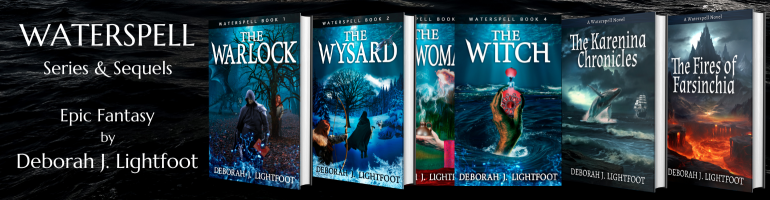
In my Waterspell trilogy, Carin is the herald. Her showing up on the property of the wizard named Verek sets the story action into motion. In effect, she will send Verek off on a quest—and she will participate fully with him on the quest, similar to how Gandalf sets Bilbo into motion and also plays his great role in the events of that story.

But behind Carin, there’s yet another herald—another character who is the one that set Carin into motion. So the events actually begin with the original herald, who is described in my Books 1 and 2 as “the wisewoman.” Readers won’t know the wisewoman’s whole story until they get to Waterspell Book 3.

But back to the beginning. When we first meet Carin in Book 1 Chapter 1, she’s not acting entirely of her own free will. The wisewoman has sent her to the wizard Verek.

One thing that complicated the writing of Chapter 1 is that I needed to at least hint that Carin isn’t really sure what her goal is, why she’s come north, or what she’s supposed to do when gets there. She only knows—or she feels, deep in her gut—that she has to be there.

In effect, she’s under a spell—a spell of compulsion. She thinks she’s acting of her own free will, but if she were pressed to explain her motives, she would be hard put to do it. This becomes clearer in Chapter 3, when Verek presses her about her reasons for trespassing on his property. Her explanations don’t satisfy him, and they will—I hope—deepen the sense of mystery that surrounds Carin.

My challenge with Chapter 1  is that many “mainstream” readers expect the main character’s goals and motivations to be clearly laid out right at the start. That’s what they have been taught to expect.

Experienced readers of fantasy, however, will understand that motives and circumstances are often quite murky as the story opens. In Philip Pullman’s The Golden Compass, for instance, the main character, Lyra, has no problem whatsoever as the story opens. She’s having fun. She’s exploring a forbidden part of the college where she lives, and she’s enjoying herself. The big problem that she will face does not become clear for a very long time, as the trilogy unfolds.

So what I’ve tried to accomplish with Chapter 1 of my fantasy is to present Carin as a strong, active, decisive character, but I’ve also had to hint that she’s been set on this course, this particular path, by forces beyond her control, by circumstances that she didn’t create. She’s being used, quite frankly, but she’s not a pawn.

In a sense, she’s like King Arthur’s sword, Excalibur. He used the sword—only Arthur as the rightful king could wield it—but Excalibur had magical powers of its own. It allowed itself to be used only by the rightful king.

My girl, Carin, very definitely has a say in how she’s being used by the original herald, the wisewoman in the south, and by the wizard Verek once she follows the wisewoman’s instructions and finds him, up in the north.

The Book 1 Prologue  helps to clarify what’s driving Carin, what her goal is, what problem she must overcome. Here’s an excerpt:

Prologue

The Path Ahead

The wisewoman never asked directly, never demanded of Carin: “Where do you come from, you strange, surprising child? Who are you?” But she breathed her questions in an undertone when she thought Carin couldn’t hear.

Time passed, and the woman watched with shrewd regard, ever wondering. What’s going on, girl, behind those cool green eyes that view the world with such detachment? You’ve borne up patiently these five years, with your gaze cast groundward to hide your thoughts from those who think you have none. Oh, you’re a self-contained little wight, as guarded in your speech as in your glances. You pretend to be indifferent to your past and resigned to your present. But I have seen you puzzling beside the millpond, gazing into its waters, wondering: ‘What brought me here? Where did this journey start, and where do I go now?’

The seasons turned, and at last the wisewoman drew Carin aside. “I have considered carefully. Indeed, child, I have thought of little else. Still I cannot fathom where your journey began. But I clearly see the path that lies before you now.”

The woman did not point. She would not risk drawing anyone’s eye to the pair standing apart. She merely tipped her head, keeping her hand hidden in the folds of her shawls, tightly gripping the amulet she had fashioned against this moment.

“Go north, girl,” she ordered, her gaze locked with Carin’s. “Run from here. You have no home in this village. Granger is much too hidebound and suspicious for the likes of you. Your place is in the North. If you belong anywhere, child, you belong there.”

Leave a Comment

Filed under Uncategorized