Those Pesky Dangling Participles

An indie author sent me her book in hopes that I’d review it. Unfortunately, I couldn’t get past the first two pages. The prose was marred by a series of dangling participles. To wit: “Turning the faucet, hot water filled the tub.” Huh? I’m not convinced that hot water has the necessary dexterity to perform such a maneuver. And: “Lighting the candles, the fragrance reminded me of perfume.” It’s an even greater stretch to picture a fragrance striking a match.

Image

My 99-cent ebook on Self-Editing offers advice for identifying and correcting common errors involving “-ing” words (my nickname for participles). Here’s an excerpt, re-posted from my old blog:

Self-Editing: Part 4

(This series begins with Part 1.)

IV. -ing Words

After using your computer to search for “ly” adverbs, then search for “-ing” words. This can be tedious — you’ll find “thing,” “ring,” “string” and other perfectly innocent words when what you’re hunting for are verb-like words that end in -ing. These “ing” words often cause trouble. You may find you’re using them to “back into” too many sentences:

Flipping her hair off her shoulder, Alice turned to go. Reaching the door, she paused. Turning to face him again, she started to speak. Thinking better of it, she stormed out.

A long string of sentences like these will drive a reader nuts. Rewrite to eliminate at least three-fourths of these sorts of “ing” opening phrases.

Also check for “danglers” that don’t quite say what you meant:

Being late to work, the boss fired her. [The boss wasn’t late. She was.]

Lying in the hammock, it struck her that Bob was OK. [A hammock with a temper?]

While walking his dog, the fire alarm sounded. [Talented fire alarm!]

Every time you find yourself using an “-ing” word to back into a sentence, consider rewriting it in solid subject-verb-object form. The result is usually clearer and crisper:

Running to the stable, he mounted his horse. He mounted while he was running? While the horse was running? It’s muddy. Simpler to say: He ran to the stable and mounted his horse.

Reaching for his gun, he fired several shots into the air. Try switching those two phrases and you’ll immediately see the problem: Firing several shots into the air, he reached for his gun. Just keep it simple and direct: He drew his gun and fired.

Crossing the stream, she tripped. Problem 1: It’s unclear. Did she trip while crossing the stream, or after crossing? Problem 2: It’s telling, not showing. This is a weak sentence that describes action that would be better shown: She waded into the freezing water. The current caught her midstream, slamming her off her feet.

Use the Find feature to locate your -ing words, and study each carefully. Recast any sentences you’re backing into, any sentences that are unclear. I don’t mean that you should eliminate all -ing words. But you should consider the value of each one, and choose carefully which to keep, which to rewrite.

Here’s a brief “-ing” opening that works:
Turning, he lifted the blackjack from the low shelf and slammed it on the counter.

With the emphasis moved to the “-ing” words, however, the sentence becomes weak and far less effective:
He turned his head, lifting the blackjack from the low shelf and slamming it on the counter.

[For more about Dangling Participles, see “Quick and Dirty Tips” from Grammar Girl.]

Leave a Comment

Filed under Uncategorized

I Swear

I’m an information junkie. I’m always collecting it — tearing articles out of magazines (yes, I still subscribe to ink-on-paper magazines); quoting the best bits I read and hear; even passing along catalogs like the one from The Teaching Company for The Great Courses.

Image

(Illustration by Corliss Elizabeth Williams for Time)


Possibly I’m a low-level hoarder. I’ve kept an article I tore out of the August 10, 2009, TIME magazine: “Why Swearing Is Good for You.” Author Tiffany Sharples says that swearing “can do more than vent frustration: it can actually reduce physical pain.” A study in Britain found that test subjects could endure painfully cold water longer while swearing. Repeating “a curse word of their choice” made the ice water feel less intensely painful.

“In swearing,” said the study’s lead author, “people have an emotional response, and it’s the emotional response that actually triggers the reduction of pain.”

I passed along a copy of that article to a writer friend who often advises his colleagues to “put more cussing” in our stories. He seems to instinctively appreciate the emotional power of swearing.

Of course, for those of us who write young-adult fiction, swearwords can be problematical. Some teachers, librarians, and parents frown on including obscenities in stories aimed at teenage (and up) readers.

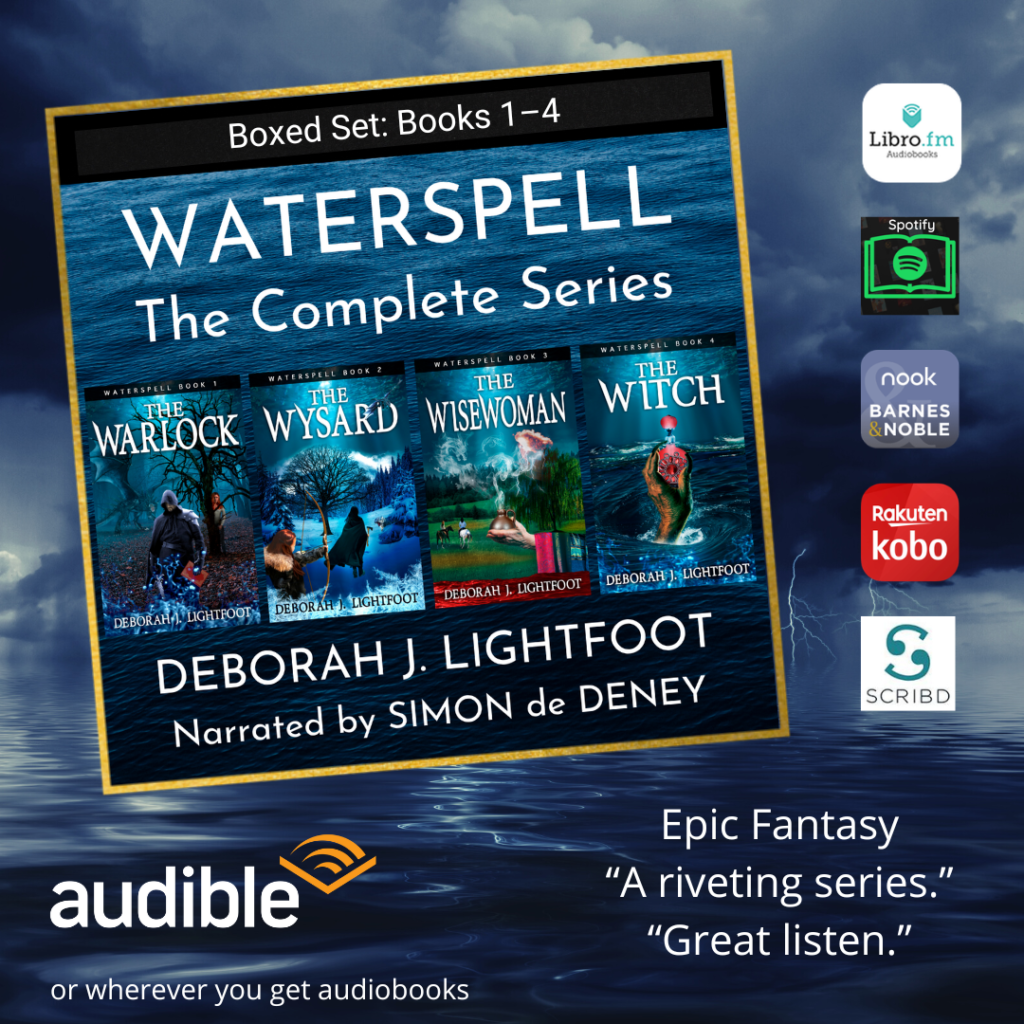
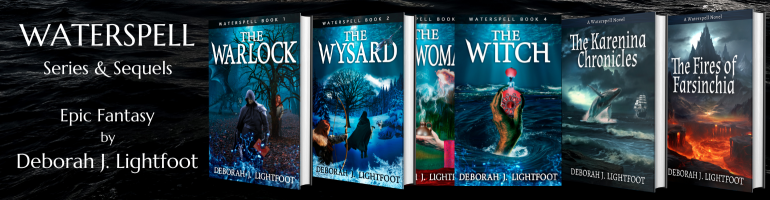
In my YA / new-adult fantasy trilogy Waterspell, my deuteragonist (the character taking the part of second importance) swears like a sailor, and my protagonist, Carin, can almost match him. Their swearing habits are essential to revealing who these characters are.

To get around the objections that would surely be raised if I had used standard American profanity, I gave my characters a different divinity to swear by. They’re in a parallel universe, so it makes sense that their holy figures would have different names than the gods do on Earth. Instead of swearing “By God!” it’s “By Drisha!” in their world.

Another helpful source of inoffensive profanity comes from old English expressions like “gorblimey,” which is a euphemism for “God blind me.” My wizard is fond of saying “Drisha blind me!” It makes people wince in his world, since it’s such a strong oath to them. But Earthlings are not offended.

In my never-ending quest for good, pain-relieving swearing, I mine sources such as old Irish fairy and folk tales. From them I’ve gotten such gems as “A thousand murders!” and “My breath and blood!”

Thanks to TIME’s Tiffany for giving me even more reasons to collect the best in profanity. My characters get into painful situations that require them to vent via a good outburst of colorful language.

1 Comment

Filed under Uncategorized

Heralds in Fantasy Literature

Heralds, in their original and simplest form, were messengers. In fantasy literature, a herald often brings the message or in some other way triggers the events, sets the events in motion.

In The Hobbit, for example, Gandalf is the herald, or the trigger, that sends Bilbo Baggins off on his grand adventure.

In my Waterspell trilogy, Carin is the herald. Her showing up on the property of the wizard named Verek sets the story action into motion. In effect, she will send Verek off on a quest—and she will participate fully with him on the quest, similar to how Gandalf sets Bilbo into motion and also plays his great role in the events of that story.

But behind Carin, there’s yet another herald—another character who is the one that set Carin into motion. So the events actually begin with the original herald, who is described in my Books 1 and 2 as “the wisewoman.” Readers won’t know the wisewoman’s whole story until they get to Waterspell Book 3.

But back to the beginning. When we first meet Carin in Book 1 Chapter 1, she’s not acting entirely of her own free will. The wisewoman has sent her to the wizard Verek.

One thing that complicated the writing of Chapter 1 is that I needed to at least hint that Carin isn’t really sure what her goal is, why she’s come north, or what she’s supposed to do when gets there. She only knows—or she feels, deep in her gut—that she has to be there.

In effect, she’s under a spell—a spell of compulsion. She thinks she’s acting of her own free will, but if she were pressed to explain her motives, she would be hard put to do it. This becomes clearer in Chapter 3, when Verek presses her about her reasons for trespassing on his property. Her explanations don’t satisfy him, and they will—I hope—deepen the sense of mystery that surrounds Carin.

My challenge with Chapter 1  is that many “mainstream” readers expect the main character’s goals and motivations to be clearly laid out right at the start. That’s what they have been taught to expect.

Experienced readers of fantasy, however, will understand that motives and circumstances are often quite murky as the story opens. In Philip Pullman’s The Golden Compass, for instance, the main character, Lyra, has no problem whatsoever as the story opens. She’s having fun. She’s exploring a forbidden part of the college where she lives, and she’s enjoying herself. The big problem that she will face does not become clear for a very long time, as the trilogy unfolds.

So what I’ve tried to accomplish with Chapter 1 of my fantasy is to present Carin as a strong, active, decisive character, but I’ve also had to hint that she’s been set on this course, this particular path, by forces beyond her control, by circumstances that she didn’t create. She’s being used, quite frankly, but she’s not a pawn.

In a sense, she’s like King Arthur’s sword, Excalibur. He used the sword—only Arthur as the rightful king could wield it—but Excalibur had magical powers of its own. It allowed itself to be used only by the rightful king.

My girl, Carin, very definitely has a say in how she’s being used by the original herald, the wisewoman in the south, and by the wizard Verek once she follows the wisewoman’s instructions and finds him, up in the north.

The Book 1 Prologue  helps to clarify what’s driving Carin, what her goal is, what problem she must overcome. Here’s an excerpt:

Prologue

The Path Ahead

The wisewoman never asked directly, never demanded of Carin: “Where do you come from, you strange, surprising child? Who are you?” But she breathed her questions in an undertone when she thought Carin couldn’t hear.

Time passed, and the woman watched with shrewd regard, ever wondering. What’s going on, girl, behind those cool green eyes that view the world with such detachment? You’ve borne up patiently these five years, with your gaze cast groundward to hide your thoughts from those who think you have none. Oh, you’re a self-contained little wight, as guarded in your speech as in your glances. You pretend to be indifferent to your past and resigned to your present. But I have seen you puzzling beside the millpond, gazing into its waters, wondering: ‘What brought me here? Where did this journey start, and where do I go now?’

The seasons turned, and at last the wisewoman drew Carin aside. “I have considered carefully. Indeed, child, I have thought of little else. Still I cannot fathom where your journey began. But I clearly see the path that lies before you now.”

The woman did not point. She would not risk drawing anyone’s eye to the pair standing apart. She merely tipped her head, keeping her hand hidden in the folds of her shawls, tightly gripping the amulet she had fashioned against this moment.

“Go north, girl,” she ordered, her gaze locked with Carin’s. “Run from here. You have no home in this village. Granger is much too hidebound and suspicious for the likes of you. Your place is in the North. If you belong anywhere, child, you belong there.”

1 Comment

Filed under Uncategorized

Awesome Indies Magical Mystery Tour: Special Book Offers and Prizes!

Image

During the Awesome Indies Magical Mystery Tour, September 27-30, you’ll have chances to pick up special offers at the blogs participating in the tour and win an awesome prize. At each blog you’ll find one scene in a mystery story, and one playing card. You’ll need to take the full tour to read the whole story and find out which card is missing from the suite. After taking the tour, return to the beginning and use the name of the missing card (e.g., Jack, King, Ace, or seventh) to enter the drawing for an Amazon gift card. (First prize is a $25 card, second prize is $15, and third prize is a $10 card.) 

The drawing ends at midnight PDT on September 30, giving you 4 days to take the tour. All you have to do is follow the links from blog to blog, read the story, note the playing card — and while you’re there, pick up the host’s special offer.

Every purchase gives you another entry into the Giveaway.

When you’ve finished, ask yourself which card is missing from the suite? The answer is the key to enter the drawing.

To get started, read on.

Image

Leave a Comment

Filed under Uncategorized